How Did We Come To Consider Corporations to Be Natural Persons? – What To Do Next?

This week’s decision by the US Supreme Court to allow corporations, including unions, to hold full rights to free speech and political action under the First Amendment to the Constitution once again reminds me of the strange practical and ethical relationship we have with corporations. In the 1886 ruling, Santa Clara County v. Southern Pacific Railroad Company1, the court reporter wrote in a summary: “The court does not wish to hear argument on the question whether the provision in the Fourteenth Amendment to the Constitution, which forbids a State to deny to any person within its jurisdiction the equal protection of the laws, applies to these corporations. We are all of the opinion that it does.”  I have not read very much at all about the history of how corporations came to be persons and I will not enter into the disputes about how this came to be. It is clearly a well established fact in our laws that corporations are people.

With this new policy handed down by the Supreme Court,  corporations can now spend unlimited amounts of money carrying out political activities. The are many troubling aspects of this situation.  Besides the obvious fact that an artificial socio-economic artifact like a corporation can not possibly be a natural person, there are numerous features of corporations that make them particularly dangerous to us human beings. Corporations never die, excepting the rare death by dissolution. Corporations act globally with many agents in place to carry out policies that favor the corporation wherever and whenever required. Through the wonders of contracts and financialization of assets corporations can appear and disappear from any locality at will. One can observe an example of this phenomenon several years ago when corporations like Tyco International moved its headquarters to an off-shore island to avoid US corporate taxes. This, despite the fact that Tyco had dozens of manufacturing facilities and other operations employing thousands here in the US.

Corporations control far more assets than even the richest of individuals, even whole countries (see the chart below). This means that they have the financial assets to buy anything and anyone they wish. Despite even the protestations of Barney Frank, one of our funniest Congressmen, whose seat is a safe one, it is simply not plausible that he can receive the enormous piles of cash from the financial services industry without him becoming beholden to them. Money is too universally corrosive to support his delusions.

Just to place the power of corporations in an appropriate global context here is some information from a report from the Institute for Policy Studies in 2000:

Of the 100 largest economies in the world, 51 are corporations; only 49 are countries (based on a comparison of corporate sales and country GDPs) (See Table 2). To put this in perspective, General Motors is now bigger than Denmark; DaimlerChrysler is bigger than Poland; Royal Dutch/Shell is bigger than Venezuela; IBM is bigger than Singapore; and Sony is bigger than Pakistan.

Table 2 referenced in this quote is below:2

Top 100 Economies in 1999 - Institute for Policy Studies

What might we do to put corporations in a more suitable position in our society and the world in general?

Perhaps we need to follow the same path that those who brought the suit Citizens United v. Federal Election Committee that resulted in the Supreme Court’s ruling. After all, I do not need to pick up the constitution anew to be sure that the word corporation nor business appears in the first amendment. In fact given the position of organizations like corporations during the Founding Father’s discussions leading to the Constitution I am sure that they would never have thought or written approvingly about corporations as natural persons. On the surface then, all we have to do is find an appropriate situation that can bring such an argument before the fundamentalists (literalists, if you like) on the court and it would seem that they would have a hard time justifying even 124 years of precedent. Where are our windmill tilters for this challenge?

  1. see the Wikipedia article on this []
  2. Source: Top 200: The Rise of Corporate Global Power by Sarah Anderson and John Cavanagh, Institute for Policy Studies December 4th, 2000. If you can find more recent data please send it along to me. Despite this being a decade old, I feel quite certain that the concentration of wealth in corporate hands has only increased, though some of the players have changed. []

Book Note – Before the Dawn: recovering the lost history of our ancestors

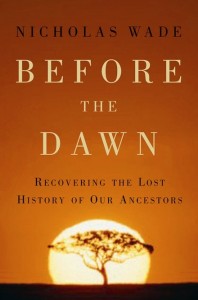
Nichola Wade, Before the DawnEarlier this year I read Charles Mann’s 1491: New Revelations of the Americas Before Columbus and was rewarded with another reminder of how thin my understanding of our hemisphere’s history is and how much new knowledge is being added by multiple disciplines. Here was a whole new world to be explored.

Nicholas Wade’s book is another must read for those of us educated before the impact of the decoding of DNA had begun. He attempts to summarize what we have learned based on contemporary genetics combining it with the vast base of earlier research from paleoanthropology, archaeology, linguistics, and other fields.

Wade opens the book with a great little story about how genetics has determined a probably date for when human beings first began wearing clothing. Based on the fact that body lice are descended from head lice and show a special adaptation specifically providing body lice with the means to hang on to the fibers of our clothing, genetics is able to date our adoption of clothing to be about 72,000 years ago “give or take a few thousand years”.

While discussing the evidence for the paths of human migration away from the African homeland, Wade mentions that the biggest region for the paucity of physical data is that because we were in glacial period, seal level was some 300 feet lower than today. Thus, since early humans would have followed the coast line to be close to a ready source of food, their early habitations are now well below water.

I won’t attempt to summarize the book. Rather I urge you to retrieve it from your local library.

Greenland and Global Warming

When I looked down into the Grand Canyon for the first time, I paused only for a moment at its immensity and moved right onto a more self-centered thought, “How tiny human history is in all of this, and even further, how much less significant my own life must be by extension.”It is clear that human beings will not outlast Nature.

An article in the January 7, 2002 New Yorker magazine, Ice Memory by Elizabeth Kolbert suggests that Nature will win out in even the shorter run than my earlier musings.
Greenland is about the size of France and 80% covered by ice. The ice sheet or glacier is over ten thousand feet thick. “A hundred and thirty-eight feet down, there is snow dating from the American Civil War; some twenty-five hundred feet down, snow from the days of Plato, and, five thousand three hundred and fifty feet down, from the time when prehistoric painters were decorating the caves at Lascaux. At the very bottom, there is snow that fell on Greenland before the last ice age, which began more than a hundred thousand years ago.”
Starting in 1959 and continuing sporadically to this day, teams from various countries have drilled down through this ice and extracted cores on four or more occasions. At first no one was very interested in the cores, but a clever Danish scientist developed a technique that allowed for an accurate reading of the atmospheric temperature at the time each layer was deposited. This involves the ratio of two oxygen isotopes in rain water that is temperature dependent.
So, what do these ice cores reveal about the earth’s climate?

“Its hard to look much further back in the record, however, without feeling a little queasy. About twenty thousand years ago, the Earth was still in the grip of the last ice age. During this period, called the Wisconsin by American scientists, ice sheets covered nearly a third of the world’s landmass, reaching as far south a New York City.
The transition out of the Wisconsin is preserved in great detail in the Greenland ice. What the record shows is that it was a period of intense instability. The temperature did not rise slowly , or even steadily; instead, the climate flipped several times from temperate conditions back into those of an ice age, and then back again. Around fifteen thousand years ago, Greenland abruptly warmed by sixteen degrees in fifty years or less. In one particularly traumatic episode some twelve thousand years ago, the mean temperature in Greenland shot up by fifteen degrees in a single decade.”

So, over the last hundred thousand years of climate history captured in the ice there have been dozens of episodes of wild swings in temperature. But, taking a longer view, the earth has oscillated through warm periods of ten thousand years followed by ninety thousand years of cold during the last half million years. The warm period we now live in is now ten thousand years old; a cold period should follow.
Although us humans are persisting in all sorts of un-neighborly activities, in the end, we may not have enough time to do ourselves in before Nature catches us.
9/2/2