
Me and Religion
(Most of this was written in mid-2014 – revised a bit in 2019)
When I was perhaps nine years old, sitting in the Congregational church that the family attended (excepting my father who only appeared to hear my mother play the organ), I heard the minister discuss “original sin”. I thought then that I had committed no original sins and couldn’t quite imagine what this had to do with me, a pudgy little boy. This religion thing was a mystery. At age fifteen, while spending a summer at music camp in Maine, I came to a further conclusion, that there was no God; I spent more time worrying about how it could be that the universe started at some point in time (the “big bang”); what existed before the “big bang”?
By the time I was in college I began to say to myself that I was an atheist. Given the tumult of the 60s, the topic of one’s religious views didn’t come up very often in my circle of acquaintances. We were more concerned about the Vietnam War, race, world capitalism, and, of course, sex, rock’n roll and drugs.
By my mid-twenties, I would occasionally tell people that I was an atheist. Overall, I followed a version of the separation of church and state policy; unless pressed, I simply didn’t discuss religion. I was very happy with the American invention of the separation of church and state enshrined in the 1st Amendment and simply generalized it to my personal life. And, during those years most of the intrusions by religions into political life seemed quite positive. Churches were very active in civil rights, anti-war activities, and many other progressive issues.
In my adult life, I have consistently treated religion as a personal matter. Though I do not believe in God and feel that organized religions are just another form of social control and domination by a minority, I didn’t say much about it except when confronted by an evangelist.
Times have changed over the last twenty years or so. The more normal role of religion, historically speaking, as a source of oppression has come back with a vengeance. Religion in the US is omnipresent and looming over many of central public questions. Even our revered separation of church and state is under attack.
And, we should not think that I am being parochial, this is a global phenomenon.
Looking at our current environment, it is time for us to confront religion in our day-to-day lives and in our politics with more honesty and vigor.
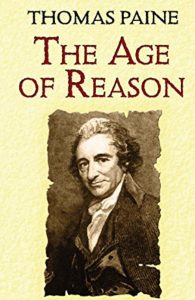 Skepticism about religion, particularly organized religions, has deep roots. For American history, the immediate sources are the French and Scottish Enlightenments. This can be seen very broadly in the so-called Founding Fathers and many others involved in the revolutionary tumult of the second half of the 18th century. Thomas Paine, most famous for his pamphlet Common Sense, wrote a longer book, The Age of Reason, that is a vigorous polemic against organized religions. Paine takes his point of departure as a deist, but in every other regard his comments about organized religions stand well to this day. He focuses on the fact that all religions (excepting perhaps a few I can’t immediately identify) are based on the “revelation” of God’s word to some chosen humans. These revelations are then enshrined in sacred writings, Torah, Bible, Koran, etc. Following the Enlightenment invention of empiricism and inductive reasoning in the scientific method, Paine took account only of observable facts and events. The hearsay of others, in this case those to whom God allegedly revealed his commandments, was of no interest.
Let me now extend this line of argument through a quote at some length from the concluding section of The Age of Reason:
“But though, speaking for myself, I thus admit the possibility of revelation, I total disbelieve that the Almighty ever did communicate anything to man, by any mode of speech, in any language, or by any kind of vision, or appearance, or by any means which our senses are capable of receiving, otherwise than by the universal display of himself in the works of the creation, and by that repugnance we feel in ourselves to bad actions, and the disposition to do good ones.
The most detestable wickedness, the most horrid cruelties, and the greatest miseries that have afflicted the human race have had their origin in this thing called revelation, or revealed religion. It has been the most dishonorable belief against the character of the Divinity, the most destructive to morality and the peace and happiness of man, that ever was propagated since man began to exist. It is better far better, that we admitted, if it is possible, a thousand devils, if there were any such, than that we permitted one such impostor and monster as Moses, Joshua, Samuel and the Bible prophets, to come with the pretended word of God in his mouth, and have credit among us.
Whence arose all the horrid assassinations of whole nations of men, women, and infants, with which the Bible is filled, and the bloody persecutions and tortures unto death, and religious wars, that since that time have laid Europe in blood and ashes – whence arose they but from this impious thing called revealed religion, and this monstrous belief that God has spoken to man? The lies of the Bible have been the cause of the one, and the lies of the Testament of the other.
Some Christians pretend that Christianity was not established by the sword; but of what period do they speak? It was impossible that twelve men could begin with the sword; they had not the power; but no sooner were the professors of Christianity sufficiently powerful to employ the sword, than they did so, and the stake and fagot, too; and Mahomet could not do it sooner.”
“What is that we have learned from this pretended thing called revealed religion? Nothing that is useful to man, and everything that is dishonorable to his maker. …….”
“As to the fragments of morality that are irregularly and thinly scattered in these books, they make no part of this pretended thing, revealed religion. They are the natural dictates of conscience, and the bonds by which society is held together, and without which it cannot exist, and nearly the same in all religions and in all societies.”
Paine’s book was published in the US in the first decade of the 19th century and widely read. It also immediately became the target of religious authorities calling for its banning. Given the author’s universal acclaim as the revolutionary pamphleteer, it is no wonder that organized religion attacked Paine and the book so vigorously.
Beyond Paine’s focus on “revealed” religion it is worth noting that all organized religions are run by men. They all oppress women in varying ways and to varying extents. Revealed, organized religions are an integral part of the patriarchical systems that so dominate the world’s politics, government, and economy.
The recent book by Susan Jacoby FREETHINKERS: A History of American Secularism provides a strong review of the history of secularism in America. I recommend it as a review and reminder of parts of American history forgotten or never learned. ……..
Leap ahead to the second half of the 20th century and the beginning of the 21st, our age. We see religion continuing to be a destructive force throughout the world. The number of conflicts, widespread mayhem, generalized viciousness, and oppression of major segments of populations (e.g., women as the single largest group of victims) in which religion has played direct or helping roles are pervasive and hardly worth enumerating. In fact, despite the progress of science, technology, and fact-centered thinking contributing to vast improvements in day-to-day life across the globe, religion maintains its power. This is evident at the level of national and international politics and in the private lives of a large portion of the human race.
In recent years I have become much more forward and public in expressing my dislike and distrust of organized religion. This occasionally leads to some uncomfortable exchanges with people I meet. But, organized religion is a force that must be dealt with.