Author Archives: markorton

1/31/2007 – Bulls Eye – Lyme disease – book review


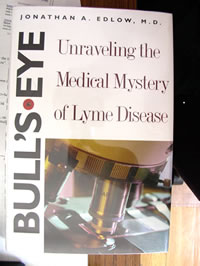
Bull’s Eye: unraveling the medical mystery of Lyme disease by Jonathan A. Edlow, M.D. (New Haven: Yale University Press, 2003)

Background
In June 2001 I came down with a mysterious illness that quickly landed me in the hospital. Before too long, I could barely walk nor readily take a pee. Sharp pains ran up and down both legs and there was a spreading lack of sensation from the waist down accompanied by extremely sensitive, constantly painful feet.After a myriad tests and proddings by all sorts of interns, residents, and specialists, it was determined that I was in fact quite sick and getting worse. Based on a recent camping trip to Cape Cod and a strange red spot in my groin area (already disappeared from sight) Lyme disease was suspected. All the other testing and probing had eliminated a large number of nasty possibilities, but the tests for Lyme revealed nothing.

Nevertheless, it was decided that, since I was continuing to get worse, we should assume a bacterial origin and start antibiotics, Ceftriaxone in this case. Well, within a day or so, my symptoms showed a small improvement. Diagnostic victory was declared. After the installation of a catheter in my arm, I was sent home for a month of intravenous treatment. Not to drag this on, by August, I was going to the office for a couple of hours a day. By New Year’s day I had started to walk on a treadmill again. Today, I am continuing to recover. L’Hermite’s Sign is almost completely gone and the chronic pains in my feet amazingly still improve. My regular physician, Stanley Sagov, always introduces me to his student doctors as, “an interesting case”, but Edward Wolpow, my neurologist has sent me on my way with the parting words, “Try not to get neurotic about this, maybe you will continue to heal, but maybe you won’t”.

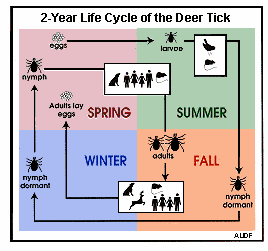
larva, nymph, adult

Deer Tick (ixodes scapularis)

 

adult tick on finger

Bull’s Eye is a terrific book on a number of levels.

First, there is the tale of how Lyme came to be recognized as a disease with appropriate backtracking to Europe and elsewhere for discussions of earlier intimations. The early phase of the discovery included mysterious rashes and arthritis that finally is recognized to have a geographic pattern. Then researchers began to do the basic epidemiological studies required. But, meanwhile all of the standard medical tests for bacteria and viruses as a potential source provided no real leads. Then, there are the examples of the various medical specialties trapped in there own worlds looking at the range of symptoms that cross fields like dermatology, rheumatology, infectious diseases, cardiology, and neurology being among the prominent ones. Since there was no clear origin for the disease, if in fact it was a disease, each specialty tended to head of on its own track.

At the request of some doctors from Yale patients began to save ticks and other insect that had bitten them. This lead finally to the deer tick. And this is a second delight of this book. the author pauses to provide fairly lengthy discussions of sometimes technical topics in an accessible language.

Meanwhile, there was still no direct connection between the ticks or any other biological agent and Lyme disease. Nevertheless, the usual trial and error of medicine had already produced two approaches to treatment, one centered on the notion that the cause was a bacterium, and the second that a virus was the troublemaker.
By the late 1980s, research has shown that Lyme disease was caused by a spirochete bacteria named B. burgdorferi that was transmitted to human beings through a bit by an infected tick, Ixodes dammini. Once infected people typically got a rash that was red, flat and round with a central clear spot, the bulls eye.

Left untreated, the rash would ultimately resolve itself. In many patients no further symptoms would arise. But in many untreated cases stage two symptoms would develop. About 15% develop neurological problems like meningitis, Bell’s palsy, radiculitis, and others. About 10% of the untreated developed inflammation of the heart and finally about 60% developed arthritis, often of the knee.

So why is Lyme disease so controversial? 

Here again, Bull’s Eye provides an educative trip through some pretty complex issues. First, there is the issue of proper diagnosis of Lyme. In my case, several tests at different times never showed that I had in fact been infected. Bull’s Eye details the problems with diagnostic tests and the likelihood of false positive and negative results. For the male of the species, this discussion was a useful revisit to the problems with the current tests for prostate cancer.

Then, there are those Lyme disease patients who develop long-term problems that are extremely resistant to treatment. And, given the vagaries of the diagnostic tools, it is perfectly possible that some or many of those late-stage patients may not be suffering from Lyme at all.

This has lead to continuing controversies about what type of antibiotics to use and how long the treatment should run. Given the fact that these intensive courses require intravenous methods, keeping a person on antibiotics for months at a time raises all sorts of issues of iatrogenic outcomes, cost, and efficacy.

Meanwhile, there was still no direct connection between the ticks or any other biological agent and Lyme disease. Nevertheless, the usual trial and error of medicine had already produced two approaches to treatment, one centered on the notion that the cause was a bacterium, and the second that a virus was the troublemaker.

By the late 1980s, research has shown that Lyme disease was caused by a spirochete bacteria named B. burgdorferi that was transmitted to human beings through a bit by an infected tick, Ixodes dammini. Once infected people typically got a rash that was red, flat and round with a central clear spot, the bulls eye.

You might ask, “How do I avoid Lyme?”  The answer is, “With difficulty.”

As a closing note, if you develop any of the symptoms of the “acute” stage, get yourself immediately to a doctor. A standard course of oral antibiotics has proven to be amazingly effective in controlling this nasty disease.


Symptoms

Here is a list of symptoms taken from the American Lyme Disease Foundation web site (these match up very well with the Appendix B list in Bull’s Eye):

Localized Early (Acute) Stage:

  • Solid red or bull’s-eye rash, usually at site of bite
  • Swelling of lymph glands near tick bite
  • Generalized achiness
  • Headache

Early Disseminated Stage:

  • Two or more rashes not at site of bite
  • Migrating pains in joints/tendons
  • Headache
  • Stiff, aching neck
  • Facial palsy (facial paralysis similar to Bell’s palsy)
  • Tingling or numbness in extremities
  • Multiple enlarged lymph glands
  • Abnormal pulse
  • Sore throat
  • Changes in vision
  • Fever of 100 to 102 F
  • Severe fatigue

Late Stage:

  • Arthritis (pain/swelling) of one or two large joints
  • Disabling neurological disorders (disorientation; confusion; dizziness; short-term memory loss; inability to concentrate, finish sentences or follow conversations; mental “fog”)
  • Numbness in arms/hands or legs/feet

A New Age Now Begins: a people’s history of the American revolution – book review

Book Review:

Image result for page smith a people's historyPage Smith, A New Age Now Begins: a people’s history of the American revolution. 2 vols., 1896pp. Index. Bibliographic note.(New York: Penguin Books, 1976.)

This huge work on the American Revolution covers everything from the politics of the war in England to obscure interactions with Indian tribes in Ohio. As a “people’s history” there is a very real focus on not just what George Washington did but also how ordinary citizens reacted and participated. And, its very size allows Smith to provide lots of discussion of naval engagements and a myriad of other aspects that never made it to high school history. A key organizing element in the book is the continuing appearance of people who played roles throughout the revolution. For instance, an American foot soldier wrote a lengthy diary whose descriptions appear throughout and provide a unifying motif to the narrative.

An early chapter describes the origins of the peoples who inhabited the colonies. This is a real eye-opener. The population was very diverse across the whole country north to south, though somewhat more homogeneous at the local level.

A key question is what motivated the ordinary soldiers of the state militias, the continental army (this is George Washington’s outfit) and the numerous armed bands to suffer the trials of military life for so many years. This remains somewhat of a mystery to me. In recent centuries governments have devised various compulsions to fill their militaries. But, in the case of the American revolution, it was extremely easy to avoid direct participation, though not encounters with the war.

Throughout the revolution the perceptions and attitudes of the British leadership, both in the America’s and in England, play a crucial role in the conduct and ultimate outcome of the struggle. British arrogance towards Americans and even towards their own hired troops, the Hessians, and their almost complete failure to understand the Americans.

I recommend this history. It is currently out of print, but available in libraries and used at Amazon.com

Manias, Panics, and Crashes: a history of financial crises – book review

Book Review

Manias, Panics, and Crashes: a history of financial crises, fourth edition by Charles P. Kindleberger (New York: Wiley 2000)

A recent Wall St Journal article described this book as a “must read” classic for anyone involved in financial markets. I have been involved directly in financial markets in two ways recently. First, I spent a year chasing around chasing angel investors and venture capitalists during the DotCom boom to fund Valuedge (the software company I co-founded in 1999 and left in 2004, though I still hold a large ownership interest).  Second, I receive quarterly statements for my 401K retirement investments. Primarily driven by my experiences with Valuedge and the phenomenal boom time of the DotCom era, I read through Kindleberger’s durable book (originally published in 1978 and never out of print since).

Although I have come to refer to the year 2000 as the Tulip Phase of Valuedge after the well-known Dutch tulipmania in the 1630s. Little did I know that financial bubbles, booms, and the inevitable crashes and depressions are a very common feature of capitalism. The first couple of chapters describe or mention dozens of bubbles and booms located around an amazing array of geopolitical centers. These have been focused on anything and everything: the well-known tulips in the 1630s; railroads; copper; English country houses; agricultural land; private companies going public (Britain 1888, US 1928 and IPOs 1998-2000); and many others.

The first lesson, then, is that booms and speculative bubbles are a commonplace feature of the capitalist world.

So, why do these bubbles and speculative manias occur? The answers are complex, involving human psychology, malfeasance, regulation (or lack), banks, and government. Read Kindleberger .

An important explicit message from Kindleberger is that economists’ models of “homo economicus” and “the market” are far from a useful mirror of what actually goes on. People are not even vaguely rational in their economic behavior and markets never constructively approach the model of a market found in Econ 101 or for that matter anywhere else that I have ever heard of.

This is not just an academic concern. In recent years our politics has displayed a dominant rhetoric that calls for the application of “market solutions” to almost every area of our lives, particularly those where traditionally we expect government to provide services, regulations, etc. Instead, we now reflexively think that “market solutions” are inherently more efficient and effective than government services. Liberals, trapped in their abandonment of even the moderate criticism of capitalism that the Catholic Church, for instance, engages, have provided no useful critique of “market solutions” as a universal policy approach.

At a practical level, this public policy fixation on “market solutions” combined with a generalized attack on all government spending, is driving a generalized impoverishment of the public infrastructure of our civil society and not coincidentally an enrichment of the wealthy and particularly the super-rich.

I recommend this book to anyone with an interest in the day-to-day political and economic life of the world.

10/28/2006

2/2/2006 – The Healthcare Crisis

The Healthcare Crisis

The healthcare crisis in the US is growing in severity and yet is not the subject of any real public debate. More than 44 million Americans are without health insurance and almost 65 million will experience a lack of coverage during the year. Emergency rooms are the primary care provider of necessity. All of this despite the fact that, as a nation, we spend more than any other country in the world; 11% more than the next closest country; 90% to 100% more than countries like Germany, Japan, Canada, Australia, and France. Yet the outcomes for our healthcare system are completely second tier and nearly third world.

You may be shocked to see exactly how poorly our phenomenally expensive health system is performing. Just to add some further context, note that Sweden (1st in Infant Mortality to the US 41st position) has a per capita income roughly equal to that of Mississippi (the poorest US state) and spends almost exactly half of what the US does per capita on health care. Examine the Comparative Health System Data in which I have color-coded a few countries for quick comparison.

During our quadrennial presidential personality sweepstakes, neither candidate offered real solutions, really not even a discussion of the issues. We are stuck in a political environment in which neither the Republicans nor the Democrats are offering, and I would argue, are capable of offering real solutions.

Lets make a one basic observation about the situation:

This is not a money problem. As demonstrated by the data on the Comparative Health System Data chart, we clearly are spending enough money in aggregate.

But, this crisis is about money, namely, who gets it and what do they do with it. And, starting from the last serious attempt to tackle the problem during the first year of the Clinton administration, it is very clear that the political system is completely in the pockets of the various interests who have the money now, namely insurance and drug companies, hospitals, and doctors.

It seems obvious to me that we just need to look at any of a number of the top performing countries for the solution. Then, we need to have the political forces in place to tell some of the current participants that the rules have changed.

Central to any solution will be the participation of all US residents in the system. Healthcare is a basic human right and we should not be treated as “risk” factors in insurance company profit calculations. If everyone is part of the healthcare system, then we can effectively share the individual risks and expenses of healthcare across the whole population. Healthcare should not be an actuarial game to derive profit. It should be a system that delivers a reasonable level of service to everyone in the society.

Two players clearly are at the top of the hit list. First, most assuredly the insurance industry, which adds no value to our health care, but consumes by many estimates 15% to 20% of the resources, must go. Second, the drug companies can be brought into reasonable competition for prices that will bring market forces to bear.

Ironically, given the long history of doctors opposing national or single-payer systems in the US, doctors have now been reduced to the status of wage slaves like the rest of us. Many, if not a solid majority of doctors, will support real reforms to the system.

I close here with two basic notions:

  • our healthcare problems are not about a lack of money, and
  • we need to develop political forces that can overcome the control of government (Federal and state) health policies by the current players in the healthcare system.

Given the current Bush administration, I believe the focus of reform must be at the state level. It seems feasible to envision a single-payer system that covers all residents in a state like Massachusetts. We should try it.

Solving the Health Care Crisis in the US – some data

Comparative Health System Data


Health Spending per
Capita 2002

Infant Mortality per 1000 Births 2003

Life Expectancy in Years at Birth 2003

1

United States

$4,271

1

Sweden

3.44

1

Andorra

83.49

2

Switzerland

$3,857

2

Iceland

3.53

2

Macau

81.87

3

Norway

$3,182

3

Singapore

3.6

3

San Marino

81.43

4

Denmark

$2,785

4

Finland

3.76

4

Japan

80.93

5

Luxembourg

$2,731

5

Japan

3.84

5

Singapore

80.42

6

Iceland

$2,701

6

Norway

3.9

6

Australia

80.13

7

Germany

$2,697

7

Andorra

4.07

7

Guernsey

80.04

8

France

$2,288

8

Netherlands

4.31

8

Switzerland

79.99

9

Japan

$2,243

9

Austria

4.39

9

Sweden

79.97

10

Netherlands

$2,173

10

France

4.41

10

Hong Kong

79.93

11

Sweden

$2,145

11

Switzerland

4.42

11

Canada

79.83

12

Belgium

$2,137

12

Macau

4.44

12

Iceland

79.8

13

Austria

$2,121

13

Slovenia

4.47

13

Cayman Islands

79.67

14

Canada

$1,939

14

Belgium

4.64

14

Italy

79.4

15

Australia

$1,714

15

Germany

4.65

15

Gibraltar

79.38

16

Finland

$1,704

16

Luxembourg

4.71

16

France

79.28

17

Italy

$1,676

17

Spain

4.85

17

Monaco

79.27

18

United Kingdom

$1,675

18

Australia

4.9

18

Liechtenstein

79.25

19

Israel

$1,607

19

Liechtenstein

4.92

19

Spain

79.23

20

Ireland

$1,569

20

Guernsey

4.92

20

Norway

79.09

21

United Arab Emirates

$1,428

21

Canada

4.95

21

Israel

79.02

22

New Zealand

$1,163

22

Denmark

4.97

22

Jersey

78.93

23

Spain

$1,043

23

Gibraltar

5.4

23

Faroe Islands

78.9

24

Greece

$965

24

Ireland

5.43

24

Greece

78.89

25

Portugal

$859

25

United Kingdom

5.45

25

Aruba

78.83

26

Slovenia

$746

26

Czech Republic

5.46

26

Netherlands

78.74

27

Singapore

$678

27

Jersey

5.52

27

Martinique

78.72

28

Argentina

$654

28

Northern Mariana Islands

5.61

28

Virgin Islands

78.59

29

Uruguay

$621

29

Malta

5.72

29

Malta

78.43

30

Bahamas, The

$612

30

Monaco

5.73

30

Germany

78.42

31

Barbados

$601

31

Hong Kong

5.73

31

Montserrat

78.36

32

Korea, South

$470

32

Italy

5.76

32

New Zealand

78.32

33

Lebanon

$469

33

Portugal

5.84

33

Belgium

78.29

34

Saint Kitts and Nevis

$408

34

San Marino

6.09

34

Guam

78.27

35

Czech Republic

$380

35

New Zealand

6.18

35

Austria

78.17

36

Bahrain

$358

36

Greece

6.25

36

United Kingdom

78.16

37

Hungary

$318

37

Aruba

6.26

37

Saint Pierre and Miquelon

78.11

38

Brazil

$308

38

Man, Isle of

6.3

38

Man, Isle of

77.98

39

Chile

$289

39

Guam

6.58

39

Finland

77.92

40

Slovakia

$285

40

Faroe Islands

6.66

40

Jordan

77.88

41

Costa Rica

$257

41

United States

6.69

41

Luxembourg

77.66

42

Poland

$248

42

Taiwan

6.8

42

Guadeloupe

77.53

43

Panama

$246

43

Croatia

7.06

43

Bermuda

77.41

44

Estonia

$243

44

Cuba

7.27

44

Saint Helena

77.38

45

Mexico

$236

45

Israel

7.55

45

Ireland

77.35

46

South Africa

$230

46

Korea, South

7.58

46

Cyprus

77.27

47

Colombia

$227

47

Martinique

7.62

47

Puerto Rico

77.26

48

Dominica

$208

48

Cyprus

7.71

48

United States

77.14

49

Trinidad and Tobago

$204

49

Montserrat

7.98

49

Denmark

77.1

50

Grenada

$193

50

Saint Pierre and Miquelon

8.18

50

Taiwan

76.87

 51.

Lithuania

$183

51

New Caledonia

8.23

51

Cuba

76.8

52

Antigua and Barbuda

$179

52

Reunion

8.31

52

Anguilla

76.7

53

Venezuela

$171

53

Slovakia

8.76

53

French Guiana

76.69

54

Latvia

$166

54

Hungary

8.77

54

Kuwait

76.65

55

Jamaica

$157

55

French Polynesia

8.95

55

Costa Rica

76.43

56

Turkey

$153

56

Chile

9.12

56

Portugal

76.35

57

Saint Lucia

$151

57

Poland

9.17

57

Chile

76.35

58

Maldives

$150

58

Virgin Islands

9.21

58

Northern Mariana Islands

76.16

59

El Salvador

$143

59

Bermuda

9.28

59

Libya

76.07

60

Namibia

$142

60

Puerto Rico

9.3

60

British Virgin Islands

76.06

61

Peru

$141

61

Guadeloupe

9.3

61

Uruguay

75.87

62

Jordan

$139

62

Cayman Islands

9.89

62

Jamaica

75.85

63

Iran

$128

63

American Samoa

10.09

63

American Samoa

75.75

64

Botswana

$127

64

Nauru

10.52

64

Slovenia

75.51

65

Gabon

$122

65

Costa Rica

10.87

65

Argentina

75.48

66

Mauritius

$120

66

Kuwait

10.87

66

French Polynesia

75.45

67

Syria

$116

67

Netherlands Antilles

11.06

67

Netherlands Antilles

75.38

68

Thailand

$112

68

Barbados

11.71

68

Korea, South

75.36

69

Tunisia

$108

69

Estonia

12.32

69

Czech Republic

75.18

70

Burma

$97

70

Macedonia, The Former Yugoslav Republic of

12.54

70

United Arab Emirates

74.75

71

Dominican Republic

$95

71

French Guiana

13.22

71

Macedonia, The Former Yugoslav Republic of

74.49

72

Paraguay

$86

72

Jamaica

13.71

72

Slovakia

74.43

73

Fiji

$86

73

Tonga

13.72

73

Tunisia

74.4

74

Romania

$86

74

Fiji

13.72

74

Paraguay

74.4

75

Belarus

$85

75

Brunei

13.95

75

Croatia

74.37

 76

Belize

$82

76

Belarus

14.12

76

Brunei

74.3

77

Malaysia

$81

77

Bulgaria

14.18

77

Dominica

74.12

78

Guatemala

$78

78

Uruguay

14.25

78

Turks and Caicos Islands

74

79

Honduras

$74

79

Lithuania

14.34

79

Serbia and Montenegro

73.97

80

Bolivia

$69

80

Grenada

14.63

80

Poland

73.91

81

Kazakhstan

$62

81

Saint Lucia

14.8

81

Venezuela

73.81

82

Bulgaria

$62

82

Latvia

14.96

82

Bahrain

73.72

83

Ecuador

$59

83

Sri Lanka

15.65

83

New Caledonia

73.52

84

Nicaragua

$54

84

Saint Kitts and Nevis

15.83

84

Reunion

73.43

85

Guyana

$51

85

Dominica

15.94

85

Qatar

73.14

86

Swaziland

$46

86

United Arab Emirates

16.12

86

Saint Vincent and the Grenadines

73.08

87

China

$40

87

Saint Vincent and the Grenadines

16.15

87

Saint Lucia

73.08

88

Congo, Democratic Republic of the

$40

88

Palau

16.21

88

West Bank

72.68

89

Cape Verde

$37

89

Mauritius

16.65

89

Sri Lanka

72.62

90

Philippines

$37

90

Seychelles

16.86

90

Oman

72.58

91

Zimbabwe

$36

91

Bahamas, The

17.08

91

Albania

72.37

92

Albania

$36

92

Argentina

17.2

92

Panama

72.32

93

Bhutan

$36

93

Greenland

17.28

93

Mexico

72.3

94

Kenya

$31

94

Serbia and Montenegro

17.36

94

Bosnia and Herzegovina

72.29

95

Nigeria

$30

95

Turks and Caicos Islands

17.46

95

China

72.22

96

Turkmenistan

$30

96

Romania

18.88

96

Hungary

72.17

97

Sri Lanka

$29

97

Bahrain

19.18

97

Solomon Islands

72.1

98

Ukraine

$28

98

British Virgin Islands

19.55

98

Lebanon

72.07

99

Cote d’Ivoire

$28

99

Panama

19.57

99

Ecuador

71.89

100

Papua New Guinea

$25

100

Jordan

19.61

100

Barbados

71.84

Data  for Spending: World Bank. 2002. World Development Indicators 2002. CD-ROM. Washington, DC

Data for Infant Mortality: CIA World Factbook, December 2003

Data for Life Expectancy: CIA World Factbook, December 2003

All data courtesy of http://www.nationmaster.com/index.php (09/29/04)

8/25/2005 – Two Tales from GM

Two Tales from GM

The article in the August 8, 2005 New York Times reporting on a General Motors light truck that is manufactured in a GM plant in China and dominates that country’s minivan market has stayed with me. Perhaps, it was yesterday’s announcement of new efficiency regulations by the Bush regime that brings me to the keyboard this morning. The story, G.M. Thrives in China With Small, Thrifty Vans by Keith Bradsher reports on the history of the development of this minivan over the past ten years. “Their development was led by an American, Philip F. Murtaugh, a native of Ohio and a maverick executive who was willing to zig while the rest of G.M. was zagging. Mr. Murtaugh was able to create in China the kind of innovative environment that G.M. has struggled for decades to achieve in its American operations.”

This van gets 43 miles per gallon in city driving! GM actually can build efficient vehicles. How did this happen? It turns out that the Chinese government has vehicle efficiency regulations and simply requires this level of efficiency. So, if even GM can do this in China, imagine what they could do here if we had a government that was serious about improving our use of petroleum.

So that is the first tale.

The second tale is to imagine the fate of Mr. Murtaugh who pulled of this amazing feat of GM ingenuity. You might be entertaining thoughts that he would be brought back to Detroit to show the car city boys how to do it here. No such luck.

“A soft-spoken man in a company known for autocratic leaders, Mr. Murtaugh ran the China operations for more than nine years from his base in Shanghai, repeatedly making some of the best calls in the industry. Now he finds himself unemployed and living in a small community in rural Kentucky.

His resignation in March, at the age of 49, came shortly after senior company executives reorganized management to give more power to Detroit executives to oversee design, engineering and various manufacturing disciplines all over the world, including operations in China.”

I have been telling people for years that GM is a dinosaur, still standing perhaps, but a dinosaur waiting for the next deep recession to move it from its present status as a junk-bond-rated behemoth to the bankruptcy courts. This second tale of GM management brilliance is further evidence to bolster my case.

By the way, “Mr. Murtaugh said that he was playing a little golf now, but found himself with many idle hours.

“I’m looking for work,” he said, and then joked, “do you have a deck that needs painting?””

8/24/2005 – A Teacher – Miss Stellfox

A Teacher – Miss Stellfox


This morning’s New York Times brought this wonderful person to me. I think it too good to let slip by:

Bequest Keeps a Teacher’s Devotion Alive

By MICHAEL WINERIP

SHAMOKIN, Pa.

IF you’re lucky, once in a lifetime you have a teacher like Jean Louise Stellfox.

For 39 years Miss Stellfox taught English at Shamokin High School here in the Appalachian coal fields. She was known for never raising her voice, and yet, says Todd Kerstetter, a former student: “When we heard her footsteps in the hall, everyone shut up. She could put you in your place in a blink of the eye.” And when the bell rang to end the period? “No one budged until Miss Stellfox said you could go,” recalled Mary Anne Stump, who had Miss Stellfox in 2000, and whose mother had Miss Stellfox in 1962.

Every student in Miss Stellfox’s class had to memorize Hamlet’s soliloquy. “She felt it was good for us,” said Mr. Kerstetter (class of ’89). For the mythology unit, they had to learn all the gods – both their Greek and Roman names. Even in her advanced senior classes, she gave a spelling test every Friday. And Miss Stellfox’s students read and read – Alexander Pope, Robert Frost, Ernest Hemingway, Edith Wharton and, most of all, her beloved Shakespeare.


Miss Stellfox never married, and except for her four years away at Dickinson College, 90 minutes down the road in Carlisle, Pa., this was her only home. After her parents died in the early 1990’s, she lived by herself in the family’s small attached row house, which was just 12 feet wide, built by the coal company over a century ago.Still, Miss Stellfox was not alone. Her students were her family. “She didn’t teach you for a year and forget about you,” said Noreen Schwalm, who had her in 1965, was inspired by Miss Stellfox to become an English teacher herself and also became Miss Stellfox’s best friend. When Kayleen Rohrer ( class of 1992) married, she invited Miss Stellfox. When Eddie Korbich (1979) became an actor, Miss Stellfox made the four-hour drive to New York City to see him on Broadway.And so when Miss Stellfox died in 2003 at age 64 – killed crossing a street near her house by a hit-and-run driver – there was an overflow crowd at the funeral home. She was laid to rest near her parents, at Mount Carmel Cemetery, but even buried, Miss Stellfox was not done teaching.

Miss Stellfox may have lived frugally – when the estate was liquidated, her house sold for just $6,000 – but she had saved prodigiously and invested wisely.

Now, for the first time, it can be told: Miss Stellfox was worth over $1.5 million and left most of it to Dickinson College. Even close friends were stunned. “Is that right, over a million?” said Eugene Boughner, the recently retired Shamokin High principal, who worked with Miss Stellfox nearly 40 years. “Jean and I were close, but she was a very, very private person. I had no idea.” “My mouth dropped open a mile,” said Mary Ann Gray, Miss Stellfox’s closest living relative, a second cousin. As the will’s executor, it was Mrs. Gray’s job to round up the assets. “She had the money spread among three different banks,” said Mrs. Gray. “She didn’t want people to know. I was going from bank to bank, filling up a suitcase.” The only one aware of what she was up to was Mr. Kerstetter, her former student, and now a lawyer here, who had drawn up the will a year before her death. “At first she didn’t want to tell even me how much money she had,” recalled Mr. Kerstetter. “I said, ‘Miss Stellfox, how can we do this will?’ ” At Miss Stellfox’s request, Mr. Kerstetter contacted Dickinson about the planned gift. But while still alive, she insisted on anonymity. “She didn’t want to get hounded,” the lawyer said. “She didn’t want people knowing she had this kind of money. She was afraid they’d wine and dine her.” Miss Stellfox told Mr. Kerstetter that a visit by Robert Frost to Dickinson in 1959 helped her decide to become an English teacher, and that’s how she wanted her gift used – to bring renowned writers to campus. The first will be Ian McEwan, the British novelist and Booker Prize winner, who will visit Dickinson in late September, his $20,000 fee paid by the new Stellfox stipend. In death, Miss Stellfox was as exacting as she had been with her students in life. Every item in her house was accounted for in her will. Mrs. Gray got the Henkel Harris serpentine chest and the Mary Webb Wood hand-embroidered crewel wing chair. Mrs. Schwalm, her fellow English teacher, got the books and the blue La-Z-Boy. Each was also left $25,000. “She left instructions for which outfit, watch and jewelry she wanted to be buried in,” said Mrs. Schwalm. “All we had to do was pick the day and time.” She asked that Todd Hummel, a former student, play the organ at the Grace Lutheran Church service, and if he couldn’t make it, she’d listed two backup options. (He made it). BUT perhaps most precious of all her worldly possessions were two thick scrapbooks that she’d left behind titled “Memories of Teaching.” Inside were thousands of photos, cards and letters from students. Long after they’d gone out into the world, they were still worried they could not meet Miss Stellfox’s standards. “It is with some fear that I begin this letter, knowing full well that your keen eye is reading it,” Kay Shoyer Hooper wrote in 1991, 21 years after graduating. “For many years I have been working under that watchful eye, even though miles have separated us.” Aaron Golumbfskie, the 1992 valedictorian who went on to earn engineering degrees at Johns Hopkins and Berkeley, wrote: “This is the third time I’ve started a note to you, because in the last two there were outstanding grammatical errors!” Mary Anne Stump and Sarah Sodrick graduated in 2000, the year Miss Stellfox retired. By then the kids called her the Silver Fox (only behind her back, of course), and as teenagers do, they chronicled her every quirk, knew that she wore only dresses, never pants, knew that between meals she never snacked, and drank only water. In short, they were as mesmerized by her as their mothers and fathers had been in the 1960’s. “The power she had over our class,” said Ms. Sodrick, “not many people have that power.” Ms. Stump, now 23, is starting out as a teacher this fall. “I try to think of ways I could command respect like Miss Stellfox,” she said.

Here is the in the New York Times.original story

8/13/2005 – Moore’s Law for dumps

Moore’s Law for Trash Dumps


Yesterday’s New York Times Business page brought the cheery news that the US capacity for burying trash has sky-rocketed. Put away those catastrophic visions of our civilization disappearing under the putrid piles of its own refuse. It seems that a combination of environmental regulations and the natural tendency of monopoly to win out over mom and pop enterprise has produced a glut of dump capacity.

A new version of Moore’s Law in action.

Through a combination of consolidation and new practices our nation’s dumps are well ahead of our national culture of trash.


You can see the whole NYT’s article here.

PS – for more about Moore’s Law in it’s original formulation see the Wikipedia article here.


Secularism

Original navigation scheme for this “secularism” topic. Only the essay below was completed.

I have been doing a lot of thinking, reading, and talking about organized religion in the past year. Now I feel the need to articulate a clearer, more positive approach to this important element in our lives. Over the coming months I will populate the structure displayed above in the navigation scheme.

Here is a little essay that started on my blog, Mr. Wonderful’s Blog. Kind of got out of hand, lengthwise.

Truth is becoming more important

This may seem like an odd topic, in some ways a self-evident, circular sort of topic, but increasingly the news and the swirl of media about us has very little to do with truth. Mostly it is a mixture of bold-faced lies and whirling wisps of marketing hype. We even have the release of a little book that addresses the issue directly, On Bullshit by Harry G. Frankfurt.

Here is the first paragraph:

One of the most salient features of our culture is that there is so much bullshit. Everyone knows this. Each of us contributes his share. But we tend to take the situation for granted. Most people are rather confident of their ability to recognize bullshit and to avoid being taken in by it. So the phenomenon has not aroused much deliberate concern, nor attracted much sustained inquiry. 

I look forward to reading this little book when it becomes available at my local library.

Most of us have practical day-to-day evidence of the importance of truth in our lives. We depend on others to be truthful in their affairs with us. And, it is amazing how small gaps in truthfulness come back to bite. Further, we do not quibble about “truth” vs “Truth” or “The Truth”, nor wonder if truth is permanent, final, immutable. We know that truth is based on best efforts to understand the facts at hand. We applaud a “new” truth that explains newly discovered facts about a situation.

In addition to these day-to-day applications of truth, there are some truths that have been tested so long and so frequently that we consider them to be “facts”, even though, from a purely formal point of view, they remain just truths like any other, subject to revision, or even replacement by a completely new truth that explains the facts more clearly, more comprehensively, more consistently.

We trust in “gravity”. We no longer drink from the Broad St. pump and we get our inoculations though we may never have seen a microbe or virus, or have any real understanding of how these buggies make us sick. We expect that the lights will come on when we flip the switch and yet few of us connect this with the truth that there is a connection between magnetism and the flow of electrons that bring the light. You can easily extend this list with your own examples of truths that you depend on and that are reliably supported by an ongoing stream of facts and experience.

These kinds of truth, the kind that is subject to the challenges of new information, facts, data, as well as the probability that today’s truth may be supplanted by a better truth that explains the same or more facts in a better, simpler fashion, these truths have become commonplace only in the past 250 yrs. This system of truth has brought us the scientific technical advances that make our day-to-day lives so different from the Middle Ages and before. This is the system of truth sometime referred to as the “scientific method”. I prefer not to get bound up in epistemology. To me this is a system of truth that is practical, fact-based, and independently verifiable.

This system of truth will not be the ultimate system of truth. But, for the moment it is the best us humans have come up with.

Nevertheless, it is an enormous advance over the other systems of truth that are driven by revealed truth, the power of one individual or group to declare truth to be what they say it to be and not subject to investigation or challenge. That system of truth is the truth of autocracy and hereditary government and virtually all religions, organized or not. That system of truth frequently declares some text, a revealed text, the Bible, Koran, Torah, and others, to be sacred texts that are literally the revealed word of God. That system of truth continues to plague us as religious intolerance and hatreds, racism, sexism, tribalism, and others that drive human relations. (As a footnote, one need only read the first chapter or so of Tom Paine’s forgotten masterpiece, The Age of Reason, circa 1794-1796, to for all of the commentary required on “revealed” systems of truth.)

Ok, so, having posited that there is a method for determining truth, for developing truth, even as it is an imperfect truth because the method is continually trying to improve the accuracy and reliability of truth, why is truth becoming ever more important?

It is clear that humans as a species are, in the short run, say the next thousand years or so, absolutely the source of both the problems confronting us as a species and the potential source of the solutions.

For the first time in the history of our species, the means to destroy or significantly disrupt human societies has arrived in the hands of individuals.

During the 20th century, an individual, say Hitler, Stalin, or Mao, could inflict death on millions through a state apparatus. More recently, we have seen Pol Pot, Sadam Hussein, among others used new variants of state apparatus to kill large numbers.

But, now, in the last decade or so, nuclear and biological weapons have arrived in a state of such miniaturization, the technologies of production sufficiently locally available, that literally a handful of individuals could float a device into Boston Harbor and render the Beantown, the City on the Hill, and its adjacent multiversities uninhabited and uninhabitable.

In the same moment of time, our societies are threatening to whirl out of control and destroy the environment in which we live. Some portion of humans are living without any functioning civil society. A vast portion of human beings live at a subsistence level. Many live under oppressive state apparatus.

And again, in the same moment we have an enormously productive world capitalism that is more comprehensively reaching every part of the world. Its ability to produce in a stable fashion is unlikely based on past historical evidence. Its ability to produce a reasonable level of economic equality is definitely not in evidence.

And again, in the same moment, we have an emerging world system of scientific and technical production that should accelerate developments in a wide range of fields. However, we have no system, except for the dynamics of capitalism and state apparatus to make decisions about where to invest our human and financial capital.

A quick example is the ongoing disaster of our pharmaceutical industry. How can it be that we need another round of erectile dysfunction drugs (I refer to them as “stiff dick drugs”) when much of the world is still plagued by malaria, tuberculosis, and others? This is not happening because the drug companies are evil. This happens because we have arranged it that way. Here we see the effects of human institutions, markets and government regulations, on the production of universally significant commodities.

This is a good point to return to the proposition, “Truth is becoming more important”. The solution to our problems is to be found in unleashing the full innovative powers of truth. Any time spent on revealed texts, any time in which governments and institutions prevent humans from focusing their energies on developing truth, is time permanently lost in the search for new truths to help us out of the morass we have put ourselves in.

Let me close with an important claim: The most important fields of endeavor for truth are in politics, economics, sociology, law – all of the ways in which we organize human societies.

If we imagined our basket of scientific and technical knowledge today and could imagine a world in which every human being had access to the benefits of just this knowledge, we would have pushed the species ahead by an order of magnitude larger than all of the progress since 1800.

(I want to acknowledge two books that played a role in my thinking for this discussion: Mihaly Csikzentmihaly’s The Evolving Self (NY: Harper Collins, 1993)and Sam Harris’ The End of Faith(NY: WW Norton, 2004))

11/19/2004 – Made to Run

Made To Run

For years I have watched other runners as they go by me (and to be sure, with my galumphing pace this is the only way I experience other runners while I am out “running”). It has always struck me that humans are built to run. Many runners seem to float along with an effortless rhythm, others thump along, and others, with joints not so symmetrical in their functioning, just keep running.

A few months ago I saw a note (the reference now lost in my foggy memory) that some scientists posited that human beings had actually run large prey animals to ground because very few animals are built to run distances. So, the notion goes, humans could simply exhaust prey by outrunning them over the long distance. At the time I saw this note, I thought that it seemed to be a pleasing notion, but wondered about how these scientists could demonstrate that, in fact, this was a mode for human hunting?

Yesterday, The New York Times ran an article, “Running Extra Mile Sets Humans Apart in Primates’ World” (https://www.nytimes.com/2004/11/18/science/running-extra-mile-sets-humans-apart-in-primates-world.html) by John Noble Wilford, that adds new fuel to this notion that long-distance running is an important step in the evolution of human capabilities.

“Endurance running, unique to humans among primates and uncommon in all mammals other than dogs, horses and hyenas, apparently evolved at least two million years ago and probably let human ancestors hunt and scavenge over great distances. That was probably decisive in the pursuit of high-protein food for development of large brains.

The apparently crucial role of running in human evolution has been largely overlooked in previous research. But today, the two scientists, Dr. Dennis M. Bramble of the University of Utah and Dr. Daniel E. Lieberman of Harvard, report in the journal Nature that their analysis of the fossil record found striking anatomical evidence for the capability of prolonged running in the Homo genus, beginning about two million years ago.

By two million years ago, Dr. Bramble and Dr. Lieberman noted, early species of the Homo family, notably Homo erectus, had long, slender legs for greater strides. They had shorter arms and a narrower rib cage and pelvis. Their skulls included features to help prevent overheating. A ligament attached to the base of the skull kept their heads steady as they ran.

Although tissues do not fossilize, traces of muscle and tendon attachment points on bones of early species revealed an extensive network of springy tendons along the back of the legs and feet, including a well-developed Achilles tendon that anchored calf muscles to the heel bone. Tendons served to store and release elastic energy during running but were not needed for ordinary walking.

And there was the gluteus maximus, the muscle of the buttocks. Earlier human ancestors, like chimpanzees today, had pelvises that could support only a modest gluteus maximus, nothing like the strong buttocks of Homo.

“Have you ever looked at an ape?” Dr. Bramble said. “They have no buns.”

Dr. Lieberman, a paleontologist, explained: “Your gluteus maximus stabilizes your trunk as you lean forward in a run. A run is like a controlled fall, and the buttocks help to control it.”

The scientists compiled a list of 26 traits connected with running that early Homo specimens exhibited. It was a result of 13 years of research that started with watching pigs running on a treadmill.

“Dennis and I noticed how the pigs can’t hold their heads still while running,” Dr. Lieberman recalled. “Any good human runner keeps his head still because of the nuchal ligament, a tendon in the back of the neck.”

The scientists learned that all accomplished running animals, modern or fossil, had a mark in the skull where the nuchal ligament had been. They found it in early Homo specimens, but not in Australopithecus, the genus that lived more than three million years ago and included the 3.2-million-year-old Lucy skeleton.

“That was an epiphany for us,” Dr. Lieberman said.

Dr. Philip Rightmire, a paleoanthropologist at Binghamton University in New York, said the Bramble-Lieberman hypothesis was “a pretty compelling picture of the importance of running in human evolution, and overall, I’m very impressed.”

Here is a graphic that accompanied the NYT’s article showing anatomical features associated with the innovation towards running:

I will follow up with a visit to Nature, the journal where the original research has been published.

Run, run, run……