Category Archives: politics

Pondering at the Food Coop

November 1, 2008

So, here I am having coffee and my favorite lunch, a toasted bagel with peanut butter thinking about the approaching election. Finally this will conclude what has been an overly long campaign, but one with enormous pleasures. Assuming that Obama is not just a curiosity to all those throngs at his campaign events, we will have a President who seems bright, competent, and level-headed with an adequate level if toughness. I don’t expect the kinds of policy directions I would like to see. But, after the last eight years, really the last eleven years, just having a competent President not mired in malevolent Millennial daydreams will be a step forward.

Though I am concerned that the present problems facing us may be beyond the present political system to navigate let alone solve.

Just to mention one. Our overseas empire with almost 800 military bases (see the Base Structure Report from the Pentagon for the data) on every continent proves Eisenhower’s point about the military industrial complex, though in truth this confirms what he is said to have wanted to say, “the military-industrial-Congressional complex”. This monster that consumes almost a trillion $s every year (my calculation includes the Pentagon, CIA, NSA, Energy, and other secret intelligence/military enterprises along with the budgets for the War on Drugs and Homeland Security) continues to grow with no evidence that our security is actually improving. To the contrary, it appears that in some quarters our security may be significantly diminished.

Healthcare Crisis

Originally written in 2005

The healthcare crisis in the US is growing in severity and yet is not the subject of any real public debate. More than 44 million Americans are without health insurance and almost 65 million will experience a lack of coverage during the year. Emergency rooms are the primary care provider of necessity. All of this despite the fact that, as a nation, we spend more than any other country in the world; 11% more than the next closest country; 90% to 100% more than countries like Germany, Japan, Canada, Australia, and France. Yet the outcomes for our healthcare system are completely second tier and nearly third world.

You may be shocked to see exactly how poorly our phenomenally expensive health system is performing. Just to add some further context, note that Sweden (1st in Infant Mortality to the US 41st position) has a per capita income roughly equal to that of Mississippi (the poorest US state) and spends almost exactly half of what the US does per capita on health care. Examine the Comparative Health System Data in which I have color-coded a few countries for quick comparison.

During our quadrennial presidential personality sweepstakes, neither candidate offered real solutions, really not even a discussion of the issues. We are stuck in a political environment in which neither the Republicans nor the Democrats are offering, and I would argue, are capable of offering real solutions.

Lets make a one basic observation about the situation:

This is not a money problem. As demonstrated by the data on the Comparative Health System Data chart, we clearly are spending enough money in aggregate.

But, this crisis is about money, namely, who gets it and what do they do with it. And, starting from the last serious attempt to tackle the problem during the first year of the Clinton administration, it is very clear that the political system is completely in the pockets of the various interests who have the money now, namely insurance and drug companies, hospitals, and doctors.

It seems obvious to me that we just need to look at any of a number of the top performing countries for the solution. Then, we need to have the political forces in place to tell some of the current participants that the rules have changed.

Central to any solution will be the participation of all US residents in the system. Healthcare is a basic human right and we should not be treated as “risk” factors in insurance company profit calculations. If everyone is part of the healthcare system, then we can effectively share the individual risks and expenses of healthcare across the whole population. Healthcare should not be an actuarial game to derive profit. It should be a system that delivers a reasonable level of service to everyone in the society.

Two players clearly are at the top of the hit list. First, most assuredly the insurance industry, which adds no value to our health care, but consumes by many estimates 15% to 20% of the resources, must go. Second, the drug companies can be brought into reasonable competition for prices that will bring market forces to bear.

Ironically, given the long history of doctors opposing national or single-payer systems in the US, doctors have now been reduced to the status of wage slaves like the rest of us. Many, if not a solid majority of doctors, will support real reforms to the system.

I close here with two basic notions:

  • our healthcare problems are not about a lack of money, and
  • we need to develop political forces that can overcome the control of government (Federal and state) health policies by the current players in the healthcare system.

Given the current Bush administration, I believe the focus of reform must be at the state level. It seems feasible to envision a single-payer system that covers all residents in a state like Massachusetts. We should try it.

North Korea – a visit to the "Axis of Evil"

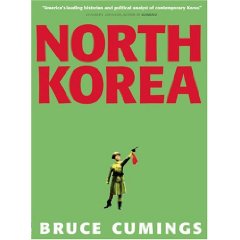
Bruce Cumings -North KoreaRecently, in the context of some discussion of the Bush regime, my step-son Jonathan pointed me towards several books on Korea. He said that Bruce Cumings is simply the best author writing in English on Korea. So, a quick trip to the local library and I had this compact little book in my hands.

The book is organized around five topics: (1) the impact of the Korean War on North Korea, (2) the genesis of Korea’s nuclear programs, (3) the legend of Kim Il Sung, (4) daily life in North Korea, and (5) the current leader (dictator) Kim Jong Il. The text is not what one might expect of an academic from the University of Chicago. Cumings writes in an openly polemic style that is directed to providing maximum exposure to North Korea and our miserable knowledge of this country.

This book is relatively brief and a compelling introduction to North Korea and a portion of our foreign policy history that was substantially new to this reader

2/2/2006 – The Healthcare Crisis

The Healthcare Crisis

The healthcare crisis in the US is growing in severity and yet is not the subject of any real public debate. More than 44 million Americans are without health insurance and almost 65 million will experience a lack of coverage during the year. Emergency rooms are the primary care provider of necessity. All of this despite the fact that, as a nation, we spend more than any other country in the world; 11% more than the next closest country; 90% to 100% more than countries like Germany, Japan, Canada, Australia, and France. Yet the outcomes for our healthcare system are completely second tier and nearly third world.

You may be shocked to see exactly how poorly our phenomenally expensive health system is performing. Just to add some further context, note that Sweden (1st in Infant Mortality to the US 41st position) has a per capita income roughly equal to that of Mississippi (the poorest US state) and spends almost exactly half of what the US does per capita on health care. Examine the Comparative Health System Data in which I have color-coded a few countries for quick comparison.

During our quadrennial presidential personality sweepstakes, neither candidate offered real solutions, really not even a discussion of the issues. We are stuck in a political environment in which neither the Republicans nor the Democrats are offering, and I would argue, are capable of offering real solutions.

Lets make a one basic observation about the situation:

This is not a money problem. As demonstrated by the data on the Comparative Health System Data chart, we clearly are spending enough money in aggregate.

But, this crisis is about money, namely, who gets it and what do they do with it. And, starting from the last serious attempt to tackle the problem during the first year of the Clinton administration, it is very clear that the political system is completely in the pockets of the various interests who have the money now, namely insurance and drug companies, hospitals, and doctors.

It seems obvious to me that we just need to look at any of a number of the top performing countries for the solution. Then, we need to have the political forces in place to tell some of the current participants that the rules have changed.

Central to any solution will be the participation of all US residents in the system. Healthcare is a basic human right and we should not be treated as “risk” factors in insurance company profit calculations. If everyone is part of the healthcare system, then we can effectively share the individual risks and expenses of healthcare across the whole population. Healthcare should not be an actuarial game to derive profit. It should be a system that delivers a reasonable level of service to everyone in the society.

Two players clearly are at the top of the hit list. First, most assuredly the insurance industry, which adds no value to our health care, but consumes by many estimates 15% to 20% of the resources, must go. Second, the drug companies can be brought into reasonable competition for prices that will bring market forces to bear.

Ironically, given the long history of doctors opposing national or single-payer systems in the US, doctors have now been reduced to the status of wage slaves like the rest of us. Many, if not a solid majority of doctors, will support real reforms to the system.

I close here with two basic notions:

  • our healthcare problems are not about a lack of money, and
  • we need to develop political forces that can overcome the control of government (Federal and state) health policies by the current players in the healthcare system.

Given the current Bush administration, I believe the focus of reform must be at the state level. It seems feasible to envision a single-payer system that covers all residents in a state like Massachusetts. We should try it.

Solving the Health Care Crisis in the US – some data

Comparative Health System Data


Health Spending per
Capita 2002

Infant Mortality per 1000 Births 2003

Life Expectancy in Years at Birth 2003

1

United States

$4,271

1

Sweden

3.44

1

Andorra

83.49

2

Switzerland

$3,857

2

Iceland

3.53

2

Macau

81.87

3

Norway

$3,182

3

Singapore

3.6

3

San Marino

81.43

4

Denmark

$2,785

4

Finland

3.76

4

Japan

80.93

5

Luxembourg

$2,731

5

Japan

3.84

5

Singapore

80.42

6

Iceland

$2,701

6

Norway

3.9

6

Australia

80.13

7

Germany

$2,697

7

Andorra

4.07

7

Guernsey

80.04

8

France

$2,288

8

Netherlands

4.31

8

Switzerland

79.99

9

Japan

$2,243

9

Austria

4.39

9

Sweden

79.97

10

Netherlands

$2,173

10

France

4.41

10

Hong Kong

79.93

11

Sweden

$2,145

11

Switzerland

4.42

11

Canada

79.83

12

Belgium

$2,137

12

Macau

4.44

12

Iceland

79.8

13

Austria

$2,121

13

Slovenia

4.47

13

Cayman Islands

79.67

14

Canada

$1,939

14

Belgium

4.64

14

Italy

79.4

15

Australia

$1,714

15

Germany

4.65

15

Gibraltar

79.38

16

Finland

$1,704

16

Luxembourg

4.71

16

France

79.28

17

Italy

$1,676

17

Spain

4.85

17

Monaco

79.27

18

United Kingdom

$1,675

18

Australia

4.9

18

Liechtenstein

79.25

19

Israel

$1,607

19

Liechtenstein

4.92

19

Spain

79.23

20

Ireland

$1,569

20

Guernsey

4.92

20

Norway

79.09

21

United Arab Emirates

$1,428

21

Canada

4.95

21

Israel

79.02

22

New Zealand

$1,163

22

Denmark

4.97

22

Jersey

78.93

23

Spain

$1,043

23

Gibraltar

5.4

23

Faroe Islands

78.9

24

Greece

$965

24

Ireland

5.43

24

Greece

78.89

25

Portugal

$859

25

United Kingdom

5.45

25

Aruba

78.83

26

Slovenia

$746

26

Czech Republic

5.46

26

Netherlands

78.74

27

Singapore

$678

27

Jersey

5.52

27

Martinique

78.72

28

Argentina

$654

28

Northern Mariana Islands

5.61

28

Virgin Islands

78.59

29

Uruguay

$621

29

Malta

5.72

29

Malta

78.43

30

Bahamas, The

$612

30

Monaco

5.73

30

Germany

78.42

31

Barbados

$601

31

Hong Kong

5.73

31

Montserrat

78.36

32

Korea, South

$470

32

Italy

5.76

32

New Zealand

78.32

33

Lebanon

$469

33

Portugal

5.84

33

Belgium

78.29

34

Saint Kitts and Nevis

$408

34

San Marino

6.09

34

Guam

78.27

35

Czech Republic

$380

35

New Zealand

6.18

35

Austria

78.17

36

Bahrain

$358

36

Greece

6.25

36

United Kingdom

78.16

37

Hungary

$318

37

Aruba

6.26

37

Saint Pierre and Miquelon

78.11

38

Brazil

$308

38

Man, Isle of

6.3

38

Man, Isle of

77.98

39

Chile

$289

39

Guam

6.58

39

Finland

77.92

40

Slovakia

$285

40

Faroe Islands

6.66

40

Jordan

77.88

41

Costa Rica

$257

41

United States

6.69

41

Luxembourg

77.66

42

Poland

$248

42

Taiwan

6.8

42

Guadeloupe

77.53

43

Panama

$246

43

Croatia

7.06

43

Bermuda

77.41

44

Estonia

$243

44

Cuba

7.27

44

Saint Helena

77.38

45

Mexico

$236

45

Israel

7.55

45

Ireland

77.35

46

South Africa

$230

46

Korea, South

7.58

46

Cyprus

77.27

47

Colombia

$227

47

Martinique

7.62

47

Puerto Rico

77.26

48

Dominica

$208

48

Cyprus

7.71

48

United States

77.14

49

Trinidad and Tobago

$204

49

Montserrat

7.98

49

Denmark

77.1

50

Grenada

$193

50

Saint Pierre and Miquelon

8.18

50

Taiwan

76.87

 51.

Lithuania

$183

51

New Caledonia

8.23

51

Cuba

76.8

52

Antigua and Barbuda

$179

52

Reunion

8.31

52

Anguilla

76.7

53

Venezuela

$171

53

Slovakia

8.76

53

French Guiana

76.69

54

Latvia

$166

54

Hungary

8.77

54

Kuwait

76.65

55

Jamaica

$157

55

French Polynesia

8.95

55

Costa Rica

76.43

56

Turkey

$153

56

Chile

9.12

56

Portugal

76.35

57

Saint Lucia

$151

57

Poland

9.17

57

Chile

76.35

58

Maldives

$150

58

Virgin Islands

9.21

58

Northern Mariana Islands

76.16

59

El Salvador

$143

59

Bermuda

9.28

59

Libya

76.07

60

Namibia

$142

60

Puerto Rico

9.3

60

British Virgin Islands

76.06

61

Peru

$141

61

Guadeloupe

9.3

61

Uruguay

75.87

62

Jordan

$139

62

Cayman Islands

9.89

62

Jamaica

75.85

63

Iran

$128

63

American Samoa

10.09

63

American Samoa

75.75

64

Botswana

$127

64

Nauru

10.52

64

Slovenia

75.51

65

Gabon

$122

65

Costa Rica

10.87

65

Argentina

75.48

66

Mauritius

$120

66

Kuwait

10.87

66

French Polynesia

75.45

67

Syria

$116

67

Netherlands Antilles

11.06

67

Netherlands Antilles

75.38

68

Thailand

$112

68

Barbados

11.71

68

Korea, South

75.36

69

Tunisia

$108

69

Estonia

12.32

69

Czech Republic

75.18

70

Burma

$97

70

Macedonia, The Former Yugoslav Republic of

12.54

70

United Arab Emirates

74.75

71

Dominican Republic

$95

71

French Guiana

13.22

71

Macedonia, The Former Yugoslav Republic of

74.49

72

Paraguay

$86

72

Jamaica

13.71

72

Slovakia

74.43

73

Fiji

$86

73

Tonga

13.72

73

Tunisia

74.4

74

Romania

$86

74

Fiji

13.72

74

Paraguay

74.4

75

Belarus

$85

75

Brunei

13.95

75

Croatia

74.37

 76

Belize

$82

76

Belarus

14.12

76

Brunei

74.3

77

Malaysia

$81

77

Bulgaria

14.18

77

Dominica

74.12

78

Guatemala

$78

78

Uruguay

14.25

78

Turks and Caicos Islands

74

79

Honduras

$74

79

Lithuania

14.34

79

Serbia and Montenegro

73.97

80

Bolivia

$69

80

Grenada

14.63

80

Poland

73.91

81

Kazakhstan

$62

81

Saint Lucia

14.8

81

Venezuela

73.81

82

Bulgaria

$62

82

Latvia

14.96

82

Bahrain

73.72

83

Ecuador

$59

83

Sri Lanka

15.65

83

New Caledonia

73.52

84

Nicaragua

$54

84

Saint Kitts and Nevis

15.83

84

Reunion

73.43

85

Guyana

$51

85

Dominica

15.94

85

Qatar

73.14

86

Swaziland

$46

86

United Arab Emirates

16.12

86

Saint Vincent and the Grenadines

73.08

87

China

$40

87

Saint Vincent and the Grenadines

16.15

87

Saint Lucia

73.08

88

Congo, Democratic Republic of the

$40

88

Palau

16.21

88

West Bank

72.68

89

Cape Verde

$37

89

Mauritius

16.65

89

Sri Lanka

72.62

90

Philippines

$37

90

Seychelles

16.86

90

Oman

72.58

91

Zimbabwe

$36

91

Bahamas, The

17.08

91

Albania

72.37

92

Albania

$36

92

Argentina

17.2

92

Panama

72.32

93

Bhutan

$36

93

Greenland

17.28

93

Mexico

72.3

94

Kenya

$31

94

Serbia and Montenegro

17.36

94

Bosnia and Herzegovina

72.29

95

Nigeria

$30

95

Turks and Caicos Islands

17.46

95

China

72.22

96

Turkmenistan

$30

96

Romania

18.88

96

Hungary

72.17

97

Sri Lanka

$29

97

Bahrain

19.18

97

Solomon Islands

72.1

98

Ukraine

$28

98

British Virgin Islands

19.55

98

Lebanon

72.07

99

Cote d’Ivoire

$28

99

Panama

19.57

99

Ecuador

71.89

100

Papua New Guinea

$25

100

Jordan

19.61

100

Barbados

71.84

Data  for Spending: World Bank. 2002. World Development Indicators 2002. CD-ROM. Washington, DC

Data for Infant Mortality: CIA World Factbook, December 2003

Data for Life Expectancy: CIA World Factbook, December 2003

All data courtesy of http://www.nationmaster.com/index.php (09/29/04)

8/13/2005 – Moore’s Law for dumps

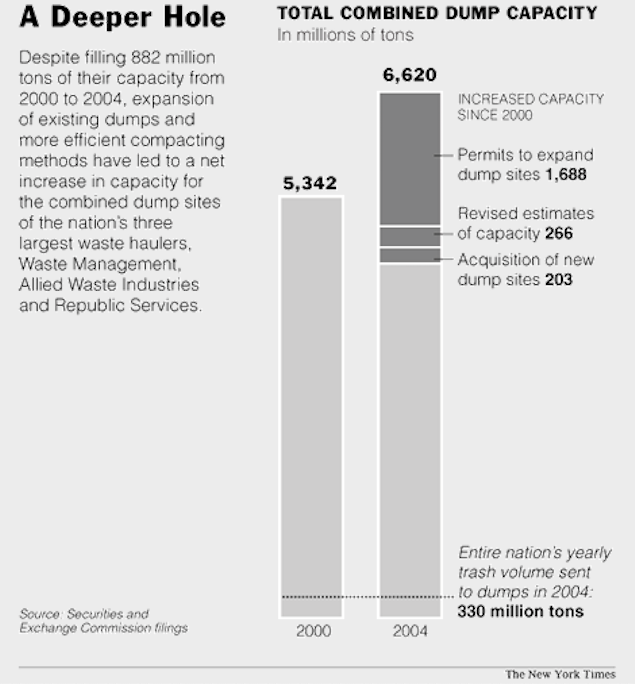
Moore’s Law for Trash Dumps


Yesterday’s New York Times Business page brought the cheery news that the US capacity for burying trash has sky-rocketed. Put away those catastrophic visions of our civilization disappearing under the putrid piles of its own refuse. It seems that a combination of environmental regulations and the natural tendency of monopoly to win out over mom and pop enterprise has produced a glut of dump capacity.

A new version of Moore’s Law in action.

Through a combination of consolidation and new practices our nation’s dumps are well ahead of our national culture of trash.


You can see the whole NYT’s article here.

PS – for more about Moore’s Law in it’s original formulation see the Wikipedia article here.


11/18/2004 – The Level of Political Discourse: a visit to the Federalist Papers

The Level of Political Discourse: a visit to the Federalist Papers

Recently I re-read parts of the Federalist Papers, the articles written by Hamilton, Jay and Madison in support of the approval of our constitution in 1787 and 1788. The strongest reaction to my brief re-visit is that the level of public discourse a little over 200 years ago was enormously higher than today. These articles, frankly written to influence the general public and published in the newspapers of the day, clearly take their audience seriously. There is no talking down, dumbing down, to use a more current phrase. Let me illustrate this with a quotation from one of the papers:

The Federalist No. 47
The Particular Structure of the New Government and the Distribution of Power Among Its Different Parts

New York Packet
Wednesday, January 30, 1788
[James Madison]

To the People of the State of New York:

HAVING reviewed the general form of the proposed government and the general mass of power allotted to it, I proceed to examine the particular structure of this government, and the distribution of this mass of power among its constituent parts.

One of the principal objections inculcated by the more respectable adversaries to the Constitution, is its supposed violation of the political maxim, that the legislative, executive, and judiciary departments ought to be separate and distinct. In the structure of the federal government, no regard, it is said, seems to have been paid to this essential precaution in favor of liberty. The several departments of power are distributed and blended in such a manner as at once to destroy all symmetry and beauty of form, and to expose some of the essential parts of the edifice to the danger of being crushed by the disproportionate weight of other parts.

No political truth is certainly of greater intrinsic value, or is stamped with the authority of more enlightened patrons of liberty, than that on which the objection is founded. The accumulation of all powers, legislative, executive, and judiciary, in the same hands, whether of one, a few, or many, and whether hereditary, self-appointed, or elective, may justly be pronounced the very definition of tyranny. Were the federal Constitution, therefore, really chargeable with the accumulation of power, or with a mixture of powers, having a dangerous tendency to such an accumulation, no further arguments would be necessary to inspire a universal reprobation of the system. I persuade myself, however, that it will be made apparent to every one, that the charge cannot be supported, and that the maxim on which it relies has been totally misconceived and misapplied. In order to form correct ideas on this important subject, it will be proper to investigate the sense in which the preservation of liberty requires that the three great departments of power should be separate and distinct.

The oracle who is always consulted and cited on this subject is the celebrated Montesquieu. If he be not the author of this invaluable precept in the science of politics, he has the merit at least of displaying and recommending it most effectually to the attention of mankind. Let us endeavor, in the first place, to ascertain his meaning on this point.

The British Constitution was to Montesquieu what Homer has been to the didactic writers on epic poetry. As the latter have considered the work of the immortal bard as the perfect model from which the principles and rules of the epic art were to be drawn, and by which all similar works were to be judged, so this great political critic appears to have viewed the Constitution of England as the standard, or to use his own expression, as the mirror of political liberty; and to have delivered, in the form of elementary truths, the several characteristic principles of that particular system. That we may be sure, then, not to mistake his meaning in this case, let us recur to the source from which the maxim was drawn.

(You can read the rest of this online at http://www.constitution.org/fed/federa47.htm)

Clearly the rhetoric here is elevated, even ornate, by today’s standards, nevertheless, still eminently readable and accessible. Madison expected the average reader to integrate knowledge of the British Constitution, Montesquieu, and Homer (to pick just the references in the passage quoted above. What can we say of today’s political discussion?


11/16/2004 – Colin Powell and Loyalty

Colin Powell and Loyalty


Colin Powell’s resignation yesterday as Secretary of State has produced an expected tsunami of blather. Much is made of his early “opposition” to the Iraq war and his loosing struggle to influence Bush foreign policy. In almost the same breath, we also hear about what a loyal team-player Powell is, always accompanied by comments about Powell’s long military career where such loyalty is required.

The last thing the US needs is more government officials who are loyal to a President. When large decisions are made, and going to war is such a large decision, moral and ethical values should be much more important than loyalty to a President. Loyalty to what is right and what is right for the larger America and the world is loyalty we should applaud.

We still have one former Secretary of Defense running around the world writing books and giving speeches that include the lines that he could not speak out about a war he knew to be wrong out of loyalty to a President. That war cost over 55,000 American lives and probably a million or more Vietnamese lives.

Is Colin Powell the next Robert McNamara? Are we going to hear in some overblown biography in ten years that Powell opposed the war, knew it was the wrong thing to do, but he couldn’t speak out because of “loyalty”? We need government officials who believe they have a duty to the larger public and will take action when they believe fundamental government policies are wrong.

11/9/2004 – Coincidence or Harbinger?

What do the following states have in common besides all having voted for Bush last week?

Texas, Missouri, Nevada, New Mexico, Kentucky, Oklahoma, North Carolina, Florida, Alabama, West Virginia, Georgia, Arkansas, South Carolina,Tennessee, Mississippi, Louisiana.

These are the bottom fifteen states in health care system performance among the 50 states for 2004. Can you guess the order of the list? Which state is 35th and which is 50th?

For the source of this data and the rest of the report click over to the United Health Foundation.


11/8/2004 – Get Out The Vote

Get Out The Vote – next time


In the aftermath of the Bush victory there has been lots of discussion about the size of the voter turnout and the relative effectiveness of the Bush campaign’s get-out-the-vote organization. One simple fact needs to be focused on: even with a turnout of 116 million in 2004, roughly 97 million potential voters did not show up. Americans are still not involved in the election process.

Here is one concept for the next quadrennial presidential circus:

Lets have a get-out-the-vote campaign that focuses on the secular vote.

Going door-to-door, you could ask a basic diagnostic question. For example, “Do you believe that the Bible is the literal word of God?” If you get a “Yes”, then move on to the next door. If you get a “No” response, then point out to the potential voter that the fundamentalists are pushing their religion into schools, government, the Supreme Court, your bedroom, music, TV, and movies, to mention a few of their targets.

With 97 million people not participating in our politics, even at the level of voting, there is plenty of room to develop a significant new base of action.

11/2/2004 – Delusions of the Overlords

Delusions of the Overlords


I ran across these statements in the November 4, 2004 New York Review of Books in a Tony Judt review “Dreams of Empire”:

“……When Donald Rumsfeld assured his troops in Baghdad that ‘unlike many armies of the world, you come not to conquer, not to occupy, but to liberate, and the Iraqi people know this’  he was decidedly unoriginal. That’s what the British General Stanley Maude said in Baghdad ninety-seven years earlier (“Our armies do not come into your cities and lands as conquerors or enemies, but as liberators”) – not to mention Napoleon Bonaparte’s proclamation upon occupying Alexandria in 1798: ‘Oh Egyptians… I have not come to you except for the purpose of restoring your rights from the hands of oppressors.’ “