Category Archives: AmericanDelusions

A catch all for reading and research. Much ends up on AmericanDelusions.com website.

11/2/2004 – Delusions of the Overlords

Delusions of the Overlords


I ran across these statements in the November 4, 2004 New York Review of Books in a Tony Judt review “Dreams of Empire”:

“……When Donald Rumsfeld assured his troops in Baghdad that ‘unlike many armies of the world, you come not to conquer, not to occupy, but to liberate, and the Iraqi people know this’  he was decidedly unoriginal. That’s what the British General Stanley Maude said in Baghdad ninety-seven years earlier (“Our armies do not come into your cities and lands as conquerors or enemies, but as liberators”) – not to mention Napoleon Bonaparte’s proclamation upon occupying Alexandria in 1798: ‘Oh Egyptians… I have not come to you except for the purpose of restoring your rights from the hands of oppressors.’ “

10/28/2004 – US Drug Laws Drive Narco States – “Cocaine Republics”

US Drug Laws Drive Narco States – “Cocaine Republics”


While waiting in the car at the airport this morning I heard a report on NPR by John Burnett, “Central America’s ‘Cocaine Republics'” (http://www.npr.org/templates/story/story.php?storyId=4117988) that reminded me of a point (see October 8, 2004 entry) I made about US drug laws supporting a global system of production and distribution that provides 24/7/365 service throughout the US.

Burnett reports that there is so much money flowing through this system that drug traffickers use “throw-away boats and weapons”. And further reported that the Columbianization of Guatemala is quickly turning that country into another narco state. The money completely overwhelms the political, police, and judicial systems.

One correction I might make to my earlier comment is that the issue is broader than US drug laws, it is really the entire developed (thats where the money is) world’s approach to drug usage.

Clearly, making drugs illegal is and has been totally ineffective at reducing or even controlling their use.

The net results of these laws is to create the environment in which capitalist methods of production and distribution are supported by an artificially high price for the drugs to produce a drug system that is comprehensive in its distribution and sales capabilities.

A second result is the imprisonment and destruction of thousands and thousands of persons for drug use and participation in the drug distribution system.

A third result is the creation of an international drug “enforcement” regime that is now a well-entrenched bureaucracy fed by billions of dollars annually.

A fourth result is the corruption of entire societies, from top to bottom, through the flows of moneys available to the narcotics industry. And, we should not doubt that many US local, state, and national police and drug “enforcement” agencies are also corrupted by this money.

We need to change our whole approach to drug use. The present legal and policy approaches are supporting the drug production and distribution system, while not reducing use.


10/13/2004 – Do We Need This Market?

Do We Need This Market?

Recently I heard a report on NPR that included the information that international currency transactions now exceed TWO TRILLION DOLLARS PER DAY. This seemed astonishing to me since the US GDP is around $12 trillion PER YEAR. After doing a bit of Googling, I have discovered varying estimates that 95% to 98% of these transactions are currency and interest speculation. And, many see this speculation as not just unproductive but deeply involved in financial crises like those involving Mexico, Russia, Brazil, Southeast Asia, just to mention some recent crises.

This speculation serves no productive purpose except to allow speculators to extract their pounds of flesh. No new products or services are funded or created by this. No people are made healthier or better educated by this activity. Economists don’t even argue vigorously that this speculation adds liquidity or responsiveness to the financial system. Many, though, see how these massive flows can easily destabilize national economies in a manner that leaves them defenseless.

Not surprisingly, I am not the first to notice this speculation. George Soros has made billions engaging in it; activist groups lobby against it; and academics write papers. James Tobin, the eminent economist, made suggestions in the early 1970s and again later to reform the international monetary system in part to discourage this destabilizing activity. You can find his paper here: http://www.globalpolicy.org/socecon/glotax/currtax/original.htm.

For those of you who still think that a market is a wonderful self-regulating engine of rational allocation I can only point you to Charles Kindleberger’s book: Manias, Panics, and Crashes: A History of Financial Crises, New York: Basic Books, 1978, revised and enlarged, 1989, 3rd ed. 1996. In fact, even if you lived through the Dot Com boom and were left thinking that markets might not be so rational, this book is a must read and a trip through a history not covered in your standard history or economics courses.

10/13/2004 – Another good deed from a US ally.

Another good deed from a US ally.

Just in case you missed this tidbit from the BBC website. I guess the mixture of oil and religious nonsense explains why the US continues to support this repressive regimes among the many all around the world?

“Saudi women barred from voting”

The Saudi interior minister has said women will not be allowed to vote in the country’s municipal elections starting in February 2005. In response to a question about women’s getting the vote, Prince Nayef bin Sultan said simply: “I don’t think that women’s participation is possible.” An election law published in August did not explicitly ban women from voting. This led many campaigners for women’s rights to hope for a substantial breakthrough for Saudi women. The Associated Press quotes an unnamed Saudi election official as saying that the main reasons for barring women from the election were administrative. The official told AP that there were not enough women electoral staff to run women-only voter registration centres, while only a fraction of women in Saudi Arabia had photo identity cards.”

10/8/2004 – 9/11 and other distractions

9/11 and other distractions


The Quadrennial Presidential Circus has refocused my thinking on how overblown and distracting all of the noise about 9/11 and Bush’s Iraq adventures have become. 9/11, in and of itself, is just a tiny flea bite on an enormous elephant. Certainly we should scratch a bit and seek to crush the flea, that goes without saying. But, the current policies are clearly headed in the wrong direction and obscuring much more important matters.

Although it would be nice to find Osama bin Laden and his brethren, the Bush approach is leading us away from increased security:

• A tramp ship floating into Boston Harbor with a nuclear device purchased in Russia nestled amidst its otherwise innocuous cargo. There are thousands and thousands of nuclear devices and tons of nuclear material floating around the former Soviet Union’s successor states. No one can be sure who is in charge or for how long? Where are the policies and programs to control and irradiate nuclear arms?

• Repeat the first scenario but instead the device is loaded into one of the millions of containers that float into US harbors every year without any system in place to inspect them.

• The US continues to support the activities of our client-states Israel and Egypt, thus, on the one hand, supporting Israel’s ongoing expansion, and, on the other hand, propping up a dictatorial regime in a core Muslim country. In general, we should be looking closely at exactly what kinds of regimes we are propping up, e.g. Pakistan, Afghanistan, Columbia.

• With the US a lead source, the world is afloat in armaments of every description. Virtually every developed country is making money from this arms trade. Other players include our client-state Israel, Brazil, Russia and China.

• The US is busy deploying a so-called antimissile system allegedly to shoot down missles from “rogue” states. China and Russia are very likely looking at this as an opening in a new US-inspired arms race.

• US drug laws support a global system of production and distribution that provides 24/7/365 service throughout the US. This drug production system is only possible because our drug laws support astronomically high prices while clearly failing completely to even marginally reduce the rate of comsumption.

I could go on. 9/11 was an unpleasant, tragic, symbolically huge event. In response, the Bush administration, supported by the whole politico-media machinery of our life, has chosen policies that are proving unsuccessful on their own terms while distracting us from larger more significant issues.

10/5/2004 – The Emperor has no clothing

Rummy and Company say, “The Emperor has no clothing”.


Just in case you missed these helpful comments by authoritative sources within the Bush world:

It was widely reported today that Secretary of Defense Rumsfeld and former occupation chief Paul Bremer made strong comments undermining the Bush camp’s Iraq war justification and execution.

The actual words Mr Rumsfeld used in his comments on Monday to the Council on Foreign Relations in New York in reference to al-Qaeda and Saddam Hussein were: “To my knowledge, I have not seen any strong, hard evidence that links the two.”

Bremer said, before an insurance industry group yesterday, “We never had enough troops on the ground,” Bremer said, while insisting that he was “more convinced than ever that regime change was the right thing to do.”

(quotes from BBC and NyTimes websites)

10/1/2004 – Bush and the Saudis

Friday

Bush and the Saudis


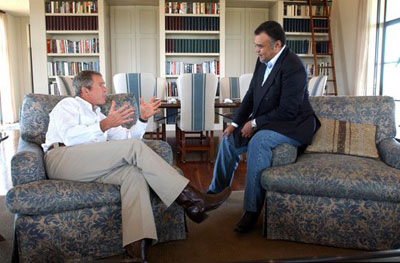
I saw this picture several months ago in the newspaper and was very struck by what it says about the relationship between Bush and Bandar, the ambassador from a foreign country. Today it popped up again in the current issue of the New York Review of Books. With only a few moments search I found the original color photo.

 
The caption in the New York Review of Books: “George W. Bush and Prince Bandar bin Sultan, Saudi Ambassador to the US, at Bush’s ranch in Crawford, TX, August 27, 2002.”

The body language and social conventions displayed here tell me the following:

This is a very comfortable social setting for the two of them, intimate even.

Bush is entirely at ease and not feeling the need to hold any poses with regard to Bandar or the presence of the photographer in the room. Bush is at a lower level looking up to Bandar.

Bandar for his part seems almost unimaginably familiar and casual with Bush. Put yourself in the living room of someone you know quite well. Would you sit on the arm of an upholstered chair to chat? Would you do this with the President of the US (or any other country for that matter)? Only if you had been in the house frequently and you were on very good relations.

Is there any further need top wonder that Bush arranged to have all of the important Saudi’s flown out of the US immediately after 9/11 while even hid mother and father could get a flight anywhere.

BTW – the credit for the photo: Eric Draper/White House website

9/29/2004 – Zinn & Chomsky at Bunker Hill Community College

Zinn & Chomsky at Bunker Hill Community College – 09/27/04


We went to Bunker Hill Community College Monday night to hear Noam Chomsky and Howard Zinn speak on the topic, “Is There Hope In This Desperate Time?”, at a fundraiser for the Homeless Empowerment Project. Our friend Linda Larson, former editor of our local street paper, Spare Change, took us along with KC Chapman from Jackson MS.

Zinn and Chomsky are two very vigorous guys even at there advancing ages.

The big take aways for me are the need for continuous political action whether it is around the war in Iraq, health insurance, homelessness, racism, whatever. Second, not surprisingly, they reiterated and supported the notion that the Republican and Democratic parties are just two different wings of a ruling elite that doesn’t want regular people involved in important issues. Chomsky said that if you are in a swing state you should go to the polls and vote for Kerry. Otherwise, vote for a candidate you like or abstain from the “quadrennial circus”. The important thing is to do something politically active on a regular basis. Voting, even in a real democracy, is just a five minute activity.

The forthcoming series of presidential debates with Kerry and Bush will illustrate how little anyone will talk about issues and how much focus there is on trivial “character” issues.

Chomsky illustrated this in the ongoing health care crisis. The US spends far more per capita on health care but produces results that are not better than Cuba or many other 3rd world countries. Attempts to change the gross inefficiencies of the health insurance and drug companies are always beaten back with phrases like “this isn’t practical”. This is just code language that the health insurance and drug company lobbies in Washington don’t want their times at the trough interrupted (or ended in the case of the useless, incredibly wasteful insurance industry).

It was bracing to hear two radicals speak so clearly and forcefully on public issues. It refocuses me on how little discussion of real issues happens in the US.

6/2/2002 – Greenland and Global Warming

an essay from the original markorton.com website:

Greenland and Global Warming

When I looked down into the Grand Canyon for the first time, I paused only for a moment at its immensity and moved right onto a more self-centered thought, “How tiny human history is in all of this, and even further, how much less significant my own life must be by extension.”

It is clear that human beings will not outlast Nature.

An article in the January 7, 2002 New Yorker magazine, Ice Memory by Elizabeth Kolbert suggests that Nature will win out in even the shorter run than my earlier musings.

Greenland is about the size of France and 80% covered by ice. The ice sheet or glacier is over ten thousand feet thick. “A hundred and thirty-eight feet down, there is snow dating from the American Civil War; some twenty-five hundred feet down, snow from the days of Plato, and, five thousand three hundred and fifty feet down, from the time when prehistoric painters were decorating the caves at Lascaux. At the very bottom, there is snow that fell on Greenland before the last ice age, which began more than a hundred thousand years ago.”

Starting in 1959 and continuing sporadically to this day, teams from various countries have drilled down through this ice and extracted cores on four or more occasions. At first no one was very interested in the cores, but a clever Danish scientist developed a technique that allowed for an accurate reading of the atmospheric temperature at the time each layer was deposited. This involves the ratio of two oxygen isotopes in rain water that is temperature dependent.

So, what do these ice cores reveal about the earth’s climate?

“Its hard to look much further back in the record, however, without feeling a little queasy. About twenty thousand years ago, the Earth was still in the grip of the last ice age. During this period, called the Wisconsin by American scientists, ice sheets covered nearly a third of the world’s landmass, reaching as far south a New York City.

The transition out of the Wisconsin is preserved in great detail in the Greenland ice. What the record shows is that it was a period of intense instability. The temperature did not rise slowly , or even steadily; instead, the climate flipped several times from temperate conditions back into those of an ice age, and then back again. Around fifteen thousand years ago, Greenland abruptly warmed by sixteen degrees in fifty years or less. In one particularly traumatic episode some twelve thousand years ago, the mean temperature in Greenland shot up by fifteen degrees in a single decade.”

So, over the last hundred thousand years of climate history captured in the ice there have been dozens of episodes of wild swings in temperature. But, taking a longer view, the earth has oscillated through warm periods of ten thousand years followed by ninety thousand years of cold during the last half million years. The warm period we now live in is now ten thousand years old; a cold period should follow.

Although us humans are persisting in all sorts of un-neighborly activities, in the end, we may not have enough time to do ourselves in before Nature catches us.

1/23/2002 – Enron, Trust, and Malfeasance

Enron, Trust, and Malfeasance

The collapse of energy giant Enron over the last six months has produced a surprising level of outrage especially for a cynic like me.

As this drama continues to unfold, I have been trying to understand how Enron structured their business and made money. Until just last night I was operating on the belief that the cleverness and sophistication of Enron’s managers simply outstripped my analytical skills. But, as I have been following the writing in the NY Times and Wall St. Journal, slowly it has come to me that they don’t understand the maze of structures and deals employed by Enron for years either.

Then, last night, on the Jim Lehrer News Hour on PBS, Paul Solman, one of the regular financial reporters, gave his analysis of what has been going on. After listening to Solman’s report, it is clear that Enron has been engaging in massive deceit, deception, and downright criminal activity for years.

Now, I must admit to some familiarity with the habits and attitudes of managers. I am used to the aggressive behavior of managers trying to stretch the accounting systems to make the most recent quarter look good. In fact, I have participated in such activities. But, Enron has engaged in a long-term shell game aided and abetted by its accounting firm, Arthur Andersen, LLC. The failure of the government (the SEC) and more importantly, the audit companies, to provide oversight, transparency, basic facts, and above all the application simple commonsense ethics to a huge company’s activities is outrageous. It undermines the credibility of the economy. If Arthur Andersen, one of the oldest and most prestigious audit firms can be so blind over so many years, what are we to make of their, and other audit firms’ reliability for oversight of all the other firms so many of us hold in our 401K funds?

It will be interesting to see how the government and the financial institutions of capitalism react to this. It is a basic tenant of the capital and equity markets that timely, transparent information is essential not only to the best and highest use of our capital resources, but also to the maintenance of trust in a reasonably fair play space.