Category Archives: 2004

10/5/2004 – The Emperor has no clothing

Rummy and Company say, “The Emperor has no clothing”.


Just in case you missed these helpful comments by authoritative sources within the Bush world:

It was widely reported today that Secretary of Defense Rumsfeld and former occupation chief Paul Bremer made strong comments undermining the Bush camp’s Iraq war justification and execution.

The actual words Mr Rumsfeld used in his comments on Monday to the Council on Foreign Relations in New York in reference to al-Qaeda and Saddam Hussein were: “To my knowledge, I have not seen any strong, hard evidence that links the two.”

Bremer said, before an insurance industry group yesterday, “We never had enough troops on the ground,” Bremer said, while insisting that he was “more convinced than ever that regime change was the right thing to do.”

(quotes from BBC and NyTimes websites)

10/1/2004 – Bush and the Saudis

Friday

Bush and the Saudis


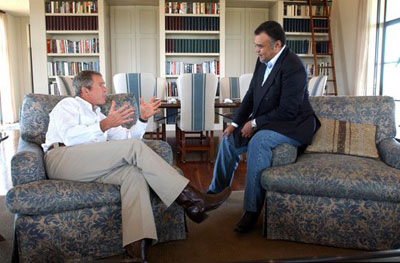
I saw this picture several months ago in the newspaper and was very struck by what it says about the relationship between Bush and Bandar, the ambassador from a foreign country. Today it popped up again in the current issue of the New York Review of Books. With only a few moments search I found the original color photo.

 
The caption in the New York Review of Books: “George W. Bush and Prince Bandar bin Sultan, Saudi Ambassador to the US, at Bush’s ranch in Crawford, TX, August 27, 2002.”

The body language and social conventions displayed here tell me the following:

This is a very comfortable social setting for the two of them, intimate even.

Bush is entirely at ease and not feeling the need to hold any poses with regard to Bandar or the presence of the photographer in the room. Bush is at a lower level looking up to Bandar.

Bandar for his part seems almost unimaginably familiar and casual with Bush. Put yourself in the living room of someone you know quite well. Would you sit on the arm of an upholstered chair to chat? Would you do this with the President of the US (or any other country for that matter)? Only if you had been in the house frequently and you were on very good relations.

Is there any further need top wonder that Bush arranged to have all of the important Saudi’s flown out of the US immediately after 9/11 while even hid mother and father could get a flight anywhere.

BTW – the credit for the photo: Eric Draper/White House website

9/29/2004 – Zinn & Chomsky at Bunker Hill Community College

Zinn & Chomsky at Bunker Hill Community College – 09/27/04


We went to Bunker Hill Community College Monday night to hear Noam Chomsky and Howard Zinn speak on the topic, “Is There Hope In This Desperate Time?”, at a fundraiser for the Homeless Empowerment Project. Our friend Linda Larson, former editor of our local street paper, Spare Change, took us along with KC Chapman from Jackson MS.

Zinn and Chomsky are two very vigorous guys even at there advancing ages.

The big take aways for me are the need for continuous political action whether it is around the war in Iraq, health insurance, homelessness, racism, whatever. Second, not surprisingly, they reiterated and supported the notion that the Republican and Democratic parties are just two different wings of a ruling elite that doesn’t want regular people involved in important issues. Chomsky said that if you are in a swing state you should go to the polls and vote for Kerry. Otherwise, vote for a candidate you like or abstain from the “quadrennial circus”. The important thing is to do something politically active on a regular basis. Voting, even in a real democracy, is just a five minute activity.

The forthcoming series of presidential debates with Kerry and Bush will illustrate how little anyone will talk about issues and how much focus there is on trivial “character” issues.

Chomsky illustrated this in the ongoing health care crisis. The US spends far more per capita on health care but produces results that are not better than Cuba or many other 3rd world countries. Attempts to change the gross inefficiencies of the health insurance and drug companies are always beaten back with phrases like “this isn’t practical”. This is just code language that the health insurance and drug company lobbies in Washington don’t want their times at the trough interrupted (or ended in the case of the useless, incredibly wasteful insurance industry).

It was bracing to hear two radicals speak so clearly and forcefully on public issues. It refocuses me on how little discussion of real issues happens in the US.

Getting Started – a progressive call to action

Thursday, September 23, 2004

Getting Started – a progressive call to action

The politics and cultural life of the US has increasingly been dominated by “the vast right-wing conspiracy” – the Bush Presidency is the culmination of formal processes underway for several decades and historical phenomena rooted in the earliest moments of the country.

These are difficult times for those of us who believe:

  • the separation of church and state (one of America’s great gifts to humanity) is fundamental to the health of our society and religious groups within it
  • our economy should produce jobs that pay a living family wage for everyone
  • health care and housing are rights for everyone
  • providing for the health and education of all children is an important duty of society as a whole and an investment in the future
  • the total costs of private enterprise activities must be kept private (for example, pollution, waste management, workforce health and injuries, etc.)
  • costs of public life should be shouldered fairly by all parties (including the rich and corporations)
  • the role of the US on the world stage is best served by a clearer focus on multilateralism, disconnecting from the neo-imperialist policies currently guided by the needs of corporate interests

We need a long-term program and platform to reenergize the progressive elements of our society. The present Democratic Party is not structured to capture the interests of the large majority of Americans who could support, out of their own self-interest, a more progressive vision.

Just as the right-wing elements have coalesced around the Republican Party and made it their vehicle over the last two-to-three decades, we need a long-term program and a platform to change the terms of the debate and move public processes in our direction to achieve our objectives.

This raise all sorts of questions. In the next few entries here I will tackle some of them.

2/10/2004 – The Interrotron – Errol Morris

In a recent visit to the movies I picked up the FLM [Magazine] (Winter 2004), a product of Landmark Theatres, and found an article by Errol Morris, “13 Questions and Answers on the Filmmaking of Errol Morris”. It contained a bit of drollery about the Interrotron.

In The Fog of War and other Morris’ movies, the interview subjects stare straight into the camera while responding to a voice interviewing them from off screen.

Here is the text lifted without permission from the magazine’s website (http://www.movienet.com/fogofwar.html). I have attempted to maintain the design and layout. I did add the picture of the Interrotron from another source.

Q Is it true that you interview people using a machine?
A Yes, the (patent pending) Interrotron. It’s a machine that uses existing technology in a new and novel way. When I made my first film, Gates of Heaven, I interviewed people by putting my head right up against the lens of the camera. I would be talking to them, and it seemed as though they were looking directly into the lens of the camera, but not really. Almost, but not quite. Of course, they were looking a little bit off to the side.

Q Why? What’s the point?
A To create the first person. When someone watches my films, it is as though the characters are talking directly to them…There is no third party. On television we’re used to seeing people interviewed 60 Minutes style. There is Mike Wallace or Larry King, and the camera is off to the side. Hence, we, the audience, are also off to the side. We’re the fly-on-the-wall, so to speak, watching two people talking. But we’ve lost something.

Q What?
A Direct eye contact.

Q Eye contact?
A Uh huh. We all know when someone makes eye contact with us. It is a moment of drama. Perhaps it’s a serial killer telling us that he’s about to kill us; or a loved one acknowledging a moment of affection. Regardless, it’s a moment with dramatic value. We know when people make eye contact with us, look away and then make eye contact again. It’s an essential part of communication. And yet, it is lost in standard interviews on film. That is, until the Interrotron.

Q I don’t get it.
A I got tired of sitting so close to the camera. (In my early films, my cameraman would grab the back of my head and pull me back because you could see the side of my head in the lens. When he yanked me back, it often hurt.) And I started to wonder, what if I could become one with the camera. What if the camera and myself could become one and the same?

Q You’re losing me.
A Well, not literally. Are you familiar with Teleprompters?

Q Not really.
A Well, Teleprompters are used to project an image on a two-way mirror. Politicians and newscasters use them so that they can read text and look into the lens of the camera at the same time. What interests me is that nobody thought of using them for anything other than to display text: read a speech or read the news and look into the lens of the camera

.
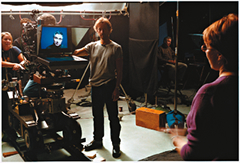
(image borrowed without permission from http://www.spin.com)

Q OK.
A I changed that. I put my face on the Teleprompter or, strictly speaking, my live video image. For the first time, I could be talking to someone, and they could be talking to me and at the same time looking directly into the lens of the camera. Now, there was no looking off slightly to the side. No more faux first person. This was the true first person.

Q It sounds like Buck Rogers. Were people willing to tolerate this?
A I worried at first. Would it frighten people? Would they run out of the studio screaming? Who could say? I used it for the first time in Fast, Cheap & Out of Control. And it worked like a charm. People loved
the Interrotron.

Q The Interrotron? Did you make up the name?
A No, it was named by my wife, Julia Sheehan. She liked the name because it combined two important concepts — terror and interview.

Q But doesn’t the device intimidate people?
A Oddly enough, no. It doesn’t. People, if anything, feel more relaxed when talking to a live video image. My production designer, Ted Bafaloukos, said, “The beauty of this thing is that it allows people to do what they do best. Watch television…” We often think of technology as
working against the possibility of intimacy. But there are so many counter-examples. The telephone is a good counter-example. There are things we can say to each other on the phone that we would never say if we were in the same room. You know, “Being there is the next best thing to using the phone…” The Interrotron is like that. It creates greater distance and greater intimacy. And it also creates the true first person. Now, when people make eye contact with me, it can be preserved on film.

Q Have you used it much?
A Whenever I need to. I used it in a film that introduced the Academy Awards® in 2002. Gorbachev, Laura Bush, Iggy Pop, Al Sharpton and Walter Cronkite have all been on the Interrotron.

Q Did Robert McNamara like it?
A Well, you have to remember that we are talking about someone who has been interviewed a thousand times. He walked into the studio and said, “What is that?” I smiled and said, “The Interrotron.” He said, “Well, whatever it is, I don’t like it.” But then he sat down, and we proceeded to record over twenty hours of interviews. I guess he came to like it, too.