Author Archives: markorton

A Suite of Plugins to Enhance Your Web Reading Pleasures

The other day I posted information about Readability, a great bookmarklet that strips away unwanted web garbage and presents text is a very reader friendly style. Since then I have come on two more web services that aid those interested in finding and reading some of the more interesting stuff on the web. The first, Instapaper,  adds to the ease of bookmarking interesting web material for later review. The second, LONGREADS, is a growing database of pieces on the web that are longer than the sound bite format that now dominates the spare real estate of web screens and the even sparer attention spans that seem to predominate these days. I have now put these three together on my web browsers and on my iPod Touch. These are my suite of web reading tools.

Instapaper screen grab

Instapaper provides you with a tool to bookmark interesting web material that you would like to review later. Unlike bookmarking material in your browser, these bookmarks live in the Web cloud and therefore are accessible to you on whatever device you happen to be using. As you bump into interesting material ion the web you simply click on the “Read Later” button in your Bookmarks bar to save it. Later when you are ready for some serious reading you bop on over to your Instapaper page and there are all of your items. Instapaper allows you to organize these in folders and also download in various formats for reading on Kindles, iPads, and so on.   See the screen grab to the left for a flavor, then go to Instapaper to set up your account and download the bookmarklets to install in your favorite web browsers.

OK. Now its time to make the reading experience more pleasant and productive. This is where Readability fits in.

I stumbled on this wonderful tool and want to share it. One of the frustrations of the Web is the enormous clutter of many web pages. This seems especially true of the magazine and newspaper style sites which feel compelled to have blizzards of sidebars, advertisements, and all sorts of other junk. Worst of all are the sites where there are moving Flash animations constantly distracting your eye from the content you might be trying to read.

Along comes this great bookmarklet. Readability from ARC90. Rather than use a lot of words, here are a before and after screen grab. You can guess which is which. Go to Readability and copy the bookmarklet to your browser tool bars. Then, try it out on this posting and see how much easier it is to read in text automatically sized to your needs and without the two sidebars present here.

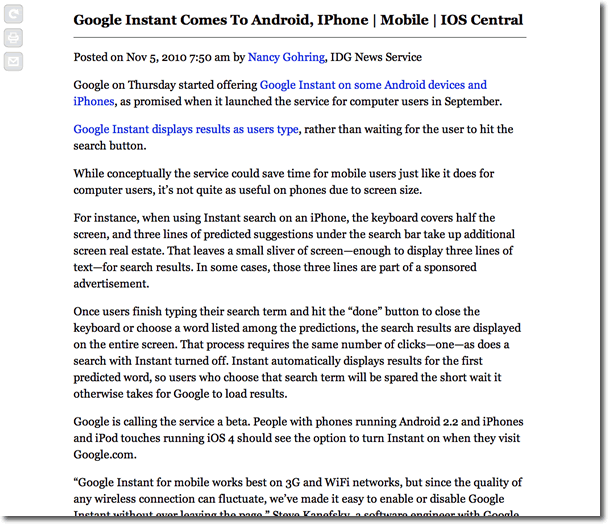
Web page before using Readability bookmarkletReadability-afterLONGREADS is a site that catalogs longer articles available on the web. You can search by length and keywords. It is a perfect closer  to this suite of tools devoted to improving reading on the web.
Making the Web More Readable – the Readability Project at ARC90

I stumbled on this wonderful tool and want to share it. One of the frustrations of the Web is the enormous clutter of many web pages. This seems especially tru of the magazine and newspaper style sites which feel compelled to have blizzards of sidebars, advertisements, and all sorts of other junk. Worst of all are the sites where there are moving Flash animations constantly distratcing your eye from the content you might be trying to read.

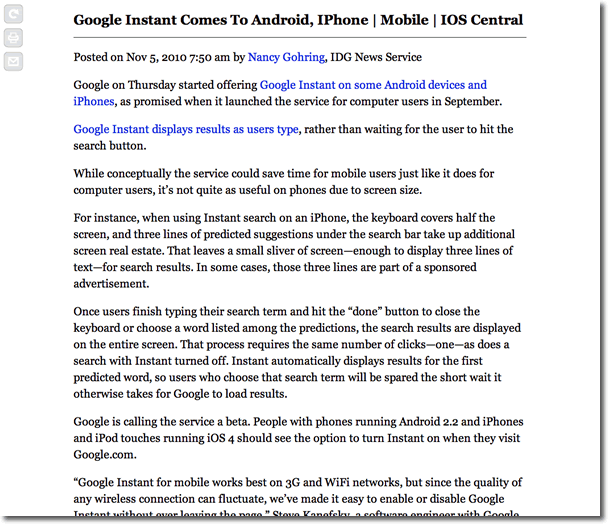
Along comes this great bookmarklet. Readability from ARC90. Rather than use a lot of words, here are a before and after screen grab. You can guess which is which.

Web page before using Readability bookmarkletWeb page after using Readability bookmarklet

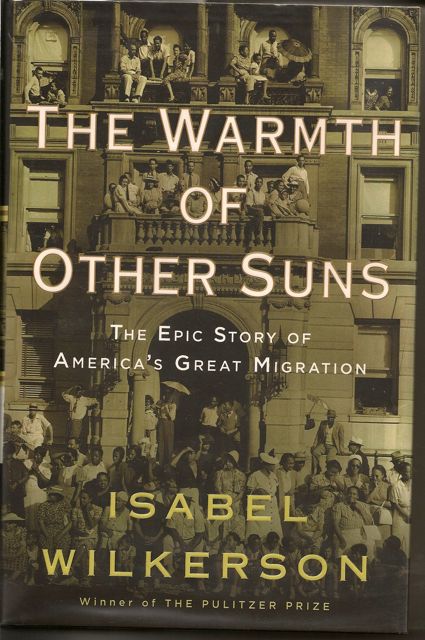
The Warmth of Other Suns – Isabel Wilkerson

Warmth of Other Suns - Isabel WilkersonIsabel Wilkerson’s book, The Warmth of Other Suns – the epic story of America’s great migration, ((New York City, Random House 2010)) creates  whole new planes of awareness of our history.

This book startled me to a new understanding of how encompassing and pervasive the Jim Crow laws and social rules of the South really were. Without much thinking on my part, I have always equated Jim Crow with images of separate water fountains, lunch counters, and schools, along with denial of voting rights. Included were images of lynchings and mob violence. Wilkerson’s work brings to life the real depth of the American system of Apartheid. These laws and social rules were so extensive as to lead to separate break times in factories so that whites and blacks would not even use a stairway at the same time.

This is the story of the six million African Americans who left the South for the North and West of the US between 1910 and WWII. Wilkerson builds her narrative of the main courses of this migration through the stories of three people leaving three different parts of the South, venturing to the three main destinations, NYC and the northeast, Chicago, and Los Angeles over three decades (teens through 40’s). Her overall research included interviews with over 1,200 people.

The stories do not end with the escape from the South. Wilkerson follows the stories as they unfold in their new environs. Here the transition from the oppressions of the South to the new realities of the north and west. No surprise the escape from the South did not mean an instant escape from racism institutionalized or otherwise. This part of the story is more familiar to a Northern urbanite.

This book, along with Douglas Blackmon’s Slavery By Another Name – the re-enslavement of Black Americans from the Civil War to WWII ((NYC Doubleday, 2008)) are compelling additions to understanding the history of racism in the US. Both are must reads.

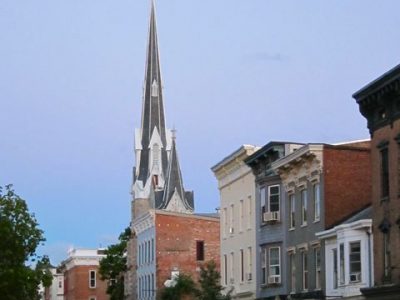
Warren St Hudson NY at dusk looking up town

9/17/2010 – Authenticity in Hudson, NY

authentic |ôˈθentik| (abbr.: auth.)

adjective

  • of undisputed origin; genuine : the letter is now accepted as an authentic document | authentic 14th-century furniture.
  • made or done in the traditional or original way, or in a way that faithfully resembles an original : the restaurant serves authentic Italian meals | every detail of the movie was totally authentic.
  • based on facts; accurate or reliable : an authentic depiction of the situation.
  • (in existentialist philosophy) relating to or denoting an emotionally appropriate, significant, purposive, and responsible mode of human life ((definition adapted from Dictionary Version 2.1.1 Apple, Inc.)

In part because of the vigorous discussion in the various “Signage” postings in the Hudson Business Coalition discussion group and other discussions I have had recently about Hudson, I have come to think that a major feature of Hudson is authenticity. Hudson demonstrates authenticity in all four senses described in the definition above. People who own businesses here, whether in antiques, art, music, and many more, do so from some central personal passion. Visitors experience this directly. Visitors must digest the experience and make it their own. And, many times businesses receive direct feedback about their passions from visitors and not in frequently new perspectives and information about their passions.

Just pay a visit to some of our B&Bs to see authenticity in action. For example, compare The Inn at Hudson and The Country Squire Bed & Breakfast. Just a hundred yards apart, but completely different experiences, each personal and real.

Orange Building - 200 block Warren St Hudson NYThis is no Disneyfied, corporate version of  life, no predigested, cleaned up tourist consumable. A visit to an art gallery here is a visit to the owner’s interests in art. The same goes for the antiques. The burgeoning music scene is filled with lots of local music. The streetscape is authentic, even the maligned Columbia-State St. streetscape. The diversity of the population is authentic and, for a town of seven thousand, quite amazing.

I hope that Hudson continues to develop, in its chaotic unplanned way, with an eye on authenticity. A strong commitment to preserving the streetscape is one obvious strategy. How to encourage and maintain authenticity in other dimensions is not so clear.

A deeper problem is the moment when we reach the tipping point and developers decide that Hudson is hot. As Jane Jacobs wrote about in The Death and Life of Great American Cities (1961) success in the real estate world leads to the death of the social world. It is one of the seemingly inevitable consequences of private property rights that the “highest and best use” (for private property owners) always wins out over any social values. That is unless there are strong countervailing forces from government and an engaged alert citizenry.

Warren St Hudson NY at dusk looking up townDuring my thirty five plus years living in Cambridge MA I watched the death of Harvard Square and its conversion into a social wasteland dominated by large institutional and corporate interests. Everything funky, fun, disruptive. original, everything that made Harvard Sq. a destination for locals, tourists, book lovers, poets, street musicians, and youth were driven out by large buildings filled with a parade of corporate logos and institutional uses. The only authentic use remaining in Harvard Sq. today is the gathering of teenagers, all from the suburbs, in the “mosh pit” around the entrance to the T.  In contrast, Central Sq. in Cambridge might be a good case study of a neighborhood that has largely escaped this fate, though its is just a long half mile from Harvard Sq. It has somehow remained quite indigestible despite inroads by Harvard, MIT and a herd of banks.


Mayor Scalera’s “Naive or delaying LWRP passage?”

Mayor Scalera’s commentary, “Naive or delaying LWRP passage?” in today’s Register Star requires some comment. Here are my comments posted on the Register Star website.

First, Mayor Scalera mis-characterizes the potential uses of the waterfront as “recreational boating and perhaps some limited shipping….”. In fact, from my perspective, and from all of the people I have heard talk about the waterfront, the uses included recreational boating, cruise operations, hotel, restaurants, retail shopping stores, galleries, and more. These uses fit into a larger picture that the future of jobs in Hudson is tied to the extension of the city as an arts, antiques, entertainment, and history destination. This job creation engine has a track record in the city and an obvious future for growth with the addition of the waterfront as part of the overall destination package.

The problem is that none of that is possible with a large scale industrial use cheek and jowl with the rest of the waterfront. The choice we are facing is a trade off between a limited number of seasonal jobs hauling gravel (it was reported elsewhere in today’s Register Star that Calarusso only operates during non-winter months) or developing the track the city has been on for the past 10 to 15 years, becoming a destination for those interested in arts, antiques, entertainment, food and history. I want to place my bet with that development path.

A second point might be to point out that Mayor Scalera went to lengths to point out the Open Space Institute and Scenic Hudson would not support an eminent domain taking. That is not the only way in which those organizations might be involved. A simpler path is the old-fashioned one of buying the land in question.

As someone who has only lived in Hudson for a year and half of the twenty three years of the LWRP process, it seems wise to continue to get the policies right even at the cost of a bit more time.

Mark Orton

Internet Service, the New York Times and Choice in the World of Mono-Duo-poly Capitalism

What Planet is the Times Orbiting?

Today’s New York Times editorial page included a piece titled “How Fast Is Your Broadband?“. It provides a reasonable review of the sad performance of the Internet service providers in the US. It is widely known that Internet service providers like Comcast, Time-Warner and locally Mid-Hudson Cable chronically provide significantly less than their advertising claims. Here in Hudson, NY Mid-Hudson claims “blazing speeds” of 5 MB/sec (download). Repeated measurements, now numbering over 280 in the last six months prove that they provide speeds 30% less than this mark. Service technicians from M-H have acknowledged that this is the typical service they provide.

Worse is that the latency frequently reaches 2 seconds instead of being under the 100 milliseconds that is commonly accepted as OK latency on the Internet.. This means that after your click your mouse on a link in a browser, you can literally count “1 Mississippi 2 Mississippi” before you get any response to your query. This latency disables common communications tools like VOIP telephone services and audio and video services via Skype or Google. Continue reading →

How Did We Come To Consider Corporations to Be Natural Persons? – What To Do Next?

This week’s decision by the US Supreme Court to allow corporations, including unions, to hold full rights to free speech and political action under the First Amendment to the Constitution once again reminds me of the strange practical and ethical relationship we have with corporations. In the 1886 ruling, Santa Clara County v. Southern Pacific Railroad Company1, the court reporter wrote in a summary: “The court does not wish to hear argument on the question whether the provision in the Fourteenth Amendment to the Constitution, which forbids a State to deny to any person within its jurisdiction the equal protection of the laws, applies to these corporations. We are all of the opinion that it does.”  I have not read very much at all about the history of how corporations came to be persons and I will not enter into the disputes about how this came to be. It is clearly a well established fact in our laws that corporations are people.

With this new policy handed down by the Supreme Court,  corporations can now spend unlimited amounts of money carrying out political activities. The are many troubling aspects of this situation.  Besides the obvious fact that an artificial socio-economic artifact like a corporation can not possibly be a natural person, there are numerous features of corporations that make them particularly dangerous to us human beings. Corporations never die, excepting the rare death by dissolution. Corporations act globally with many agents in place to carry out policies that favor the corporation wherever and whenever required. Through the wonders of contracts and financialization of assets corporations can appear and disappear from any locality at will. One can observe an example of this phenomenon several years ago when corporations like Tyco International moved its headquarters to an off-shore island to avoid US corporate taxes. This, despite the fact that Tyco had dozens of manufacturing facilities and other operations employing thousands here in the US. Continue reading →

Manias,Panics,and Crashes by Kindleberger

Book Review: Manias, Panics, and Crashes: a history of financial crises by Kindleberger

Manias, Panics, and Crashes: a history of financial crises, fourth edition by Charles P. Kindleberger (New York: Wiley 2000)

Manias,Panics,and Crashes by KindlebergerA recent Wall St Journal article described this book as a “must read” classic for anyone involved in financial markets. I have been involved directly in financial markets in two ways recently. First, I spent a year chasing around chasing angel investors and venture capitalists during the DotCom boom to fund Valuedge (the software company I co-founded in 1999 and left in 2004, though I still hold a large ownership interest).  Second, I receive quarterly statements for my 401K retirement investments. Primarily driven by my experiences with Valuedge and the phenomenal boom time of the DotCom era, I read through Kindleberger’s durable book (originally published in 1978 and never out of print since).

Although I have come to refer to the year 2000 as the Tulip Phase of Valuedge after the well-known Dutch tulipmania in the 1630s. Little did I know that financial bubbles, booms, and the inevitable crashes and depressions are a very common feature of capitalism. The first couple of chapters describe or mention dozens of bubbles and booms located around an amazing array of geopolitical centers. These have been focused on anything and everything: the well-known tulips in the 1630s; railroads; copper; English country houses; agricultural land; private companies going public (Britain 1888, US 1928 and IPOs 1998-2000); and many others.

The first lesson, then, is that booms and speculative bubbles are a commonplace feature of the capitalist world.

So, why do these bubbles and speculative manias occur? The answers are complex, involving human psychology, malfeasance, regulation (or lack), banks, and government. Read Kindleberger .

An important explicit message from Kindleberger is that economists’ models of “homo economicus” and “the market” are far from a useful mirror of what actually goes on. People are not even vaguely rational in their economic behavior and markets never constructively approach the model of a market found in Econ 101 or for that matter anywhere else that I have ever heard of.

This is not just an academic concern. In recent years our politics has displayed a dominant rhetoric that calls for the application of “market solutions” to almost every area of our lives, particularly those where traditionally we expect government to provide services, regulations, etc. Instead, we now reflexively think that “market solutions” are inherently more efficient and effective than government services. Liberals, trapped in their abandonment of even the moderate criticism of capitalism that the Catholic Church, for instance, engages, have provided no useful critique of “market solutions” as a universal policy approach.

At a practical level, this public policy fixation on “market solutions” combined with a generalized attack on all government spending, is driving a generalized impoverishment of the public infrastructure of our civil society and not coincidentally an enrichment of the wealthy and particularly the super-rich.

I recommend this book to anyone with an interest in the day-to-day political and economic life of the world.

Secret Sentry by Mathew Aid

Yottabytes and the National Security State

The current New York Review of Books has an article by James Bamford, “Who’s in Big Brother’s Database” that reviews the new book by Mathew M. Aid, The Secret Sentry: The Untold History of the National Security Agency . I have gotten in line at my local library to read this book and will make further comments after that.

Secret Sentry by Mathew AidMeanwhile, the Bamford article mentions the construction boom at NSA (National Security Agency) with a doubling of its headquarters and million sq. feet of data storage in the Utah desert costing some $2 billion. This to store the data from all of NSA’s spying that by 2015 will be spoken of in terms of yottabytes.

Now, before you think that Bamford is mainlining old Star Wars characters, a yotta- is the largest large number prefix officially recognized in the scientific lexicon. At our house we are approaching 1/2 Terabyte (1012) in our total digital stores, mostly photos. Really large corporate databases are measured in Petabytes (1015). A Yotta is 1024.

Are you feeling safer?

Do you really think that any email sent or telephone conversation you have had since 2002 or 2003 is not logged in the vast secret Security State Apparatus??

I guess that a National Security State (Empire) that has had over 800 military bases throughout the world (see an earlier posting on this topic) to assure our influence elsewhere can not resist the opportunity the state of so-called war we have been in since 2001 to penetrate into every American’s life.

10/14/2009 – Storm King – Maya Lin’s Wavefields

Maya Lin at Storm King Art Center

Storm King Wavefield, 2007–08
Earth and grass
240,000 sq. ft. (11-acre site)
 
Viewed from above, the undulating swells of earth forming Storm King Wavefield appear to naturally rise from and roll along the grassy terrain. Set against a backdrop formed by Schunnemunk Mountain to the west and the Hudson Highlands to the south and east, Maya Lin’s earthwork inspires a broad perspective on the landscape from which it emerges and entices deep exploration of the grassy alleys between the cresting peaks. The seven nearly four-hundred-foot-long waves, ranging in height from ten to fifteen feet high, proceed at the same scale as a series of mid-ocean waves. The resulting effect recalls the experience of being at sea, where sight of adjacent waves and land is lost between the swells.

Storm King Wavefield is the largest and last in a series of three of Lin’s wavefields. (The other two are located in Ann Arbor, Michigan, and Miami, Florida.) Lin selected the eleven-acre site as an environmental reclamation project, a sustainable reworking of the former gravel pit that supplied material for the New York State Thruway. When Storm King was founded in 1960, a significant portion of its grounds consisted of large stores of gravel in surrounding fields. The ravaged landscape was in turn landscaped and shaped anew by the very same gravel. This compelling, untold story excited Lin. “I’ve tended to create works on the edges and boundaries of places…. I always knew that I wanted to culminate the series with a field that literally, when you were in it, you became lost inside it.” Working with the New York State Department of Environmental Conservation, which sanctioned and supported the reclamation of the site, Lin collaborated with landscape architects to utilize the existing gravel and topsoil at the site. The low-impact grasses and natural drainage system she introduced make Wavefield an organic, living work that continues to evolve.

(borrowed from https://collections.stormking.org/Detail/objects/416)