Thursday
The main feature for me was watching one of the cats attacking the turkey carcass.
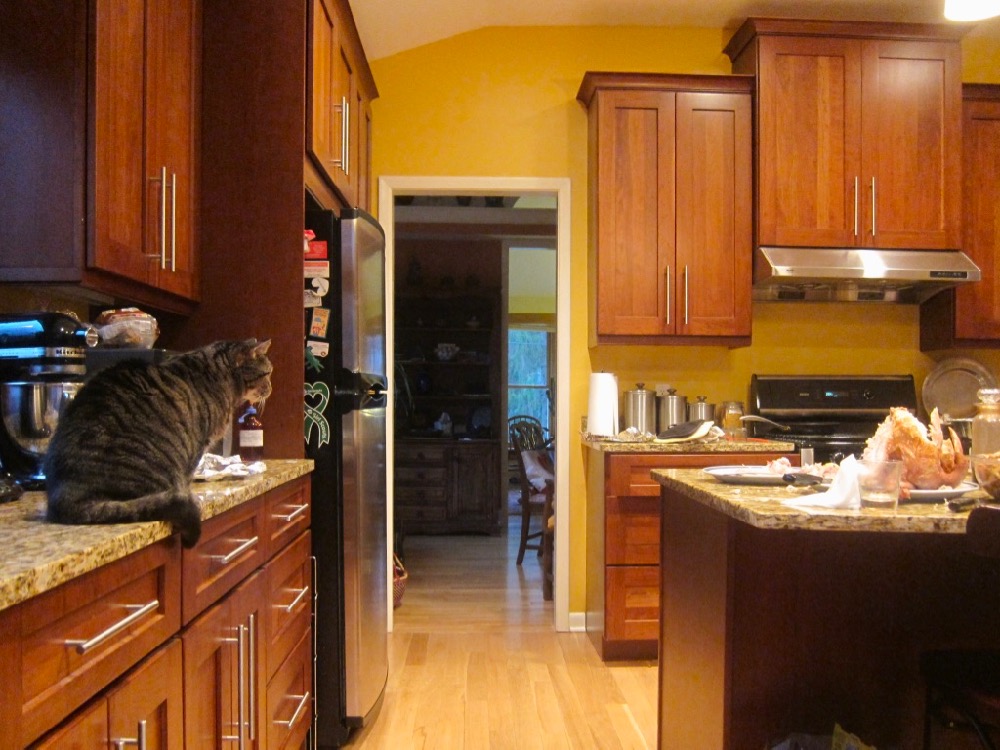



The main feature for me was watching one of the cats attacking the turkey carcass.
 This book brings to light the extent to which the Jim Crow laws were in fact part of a totalitarian system of government that ruled the South for more than seventy five years. How these laws came to be called Jim Crow by historians instead of “a system of racist oppression and exploitation” is a mystery. The fact that historians and school textbook writers adopted this term,which is derogatory in its basis, points to a shameful lack of focus on the facts of life in the South during the period between 1876 and roughly 1965. Worse it aided the systematic cover up of the actual functions of these laws and their impact on African-Americans. If the word Apartheid had been invented earlier this would also be a useful term.
The research and the writing is compelling. Blackmon has a website devoted to the book and the production of a documentary movie on PBS that will air in 2011.
Slavery by Another Name: The Re-Enslavement of Black People in America from the Civil War to World War II
Author: Douglas A. Blackmon Publisher: Doubleday, $29.95 (512p) ISBN 978-0-385-50625-0
The other day I posted information about Readability, a great bookmarklet that strips away unwanted web garbage and presents text is a very reader friendly style. Since then I have come on two more web services that aid those interested in finding and reading some of the more interesting stuff on the web. The first, Instapaper, adds to the ease of bookmarking interesting web material for later review. The second, LONGREADS, is a growing database of pieces on the web that are longer than the sound bite format that now dominates the spare real estate of web screens and the even sparer attention spans that seem to predominate these days. I have now put these three together on my web browsers and on my iPod Touch. These are my suite of web reading tools.

Instapaper provides you with a tool to bookmark interesting web material that you would like to review later. Unlike bookmarking material in your browser, these bookmarks live in the Web cloud and therefore are accessible to you on whatever device you happen to be using. As you bump into interesting material ion the web you simply click on the “Read Later” button in your Bookmarks bar to save it. Later when you are ready for some serious reading you bop on over to your Instapaper page and there are all of your items. Instapaper allows you to organize these in folders and also download in various formats for reading on Kindles, iPads, and so on. See the screen grab to the left for a flavor, then go to Instapaper to set up your account and download the bookmarklets to install in your favorite web browsers.
OK. Now its time to make the reading experience more pleasant and productive. This is where Readability fits in.
I stumbled on this wonderful tool and want to share it. One of the frustrations of the Web is the enormous clutter of many web pages. This seems especially true of the magazine and newspaper style sites which feel compelled to have blizzards of sidebars, advertisements, and all sorts of other junk. Worst of all are the sites where there are moving Flash animations constantly distracting your eye from the content you might be trying to read.
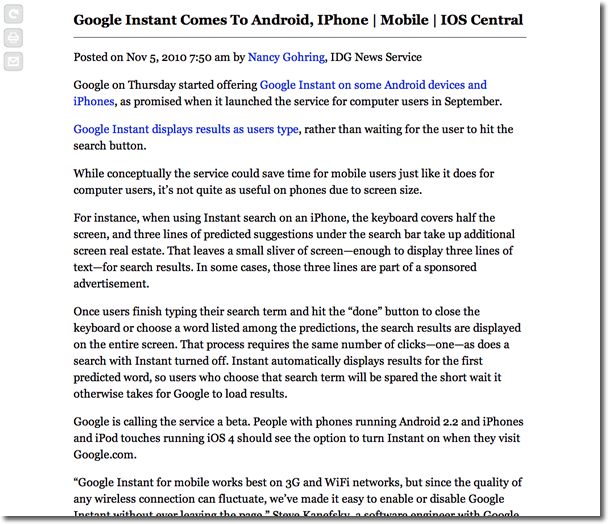
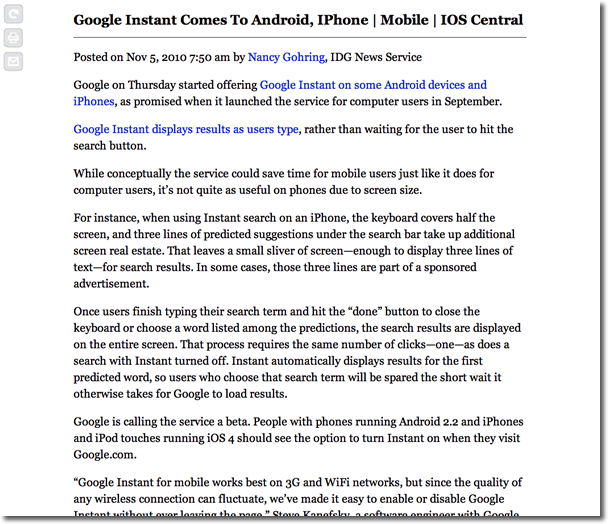
Along comes this great bookmarklet. Readability from ARC90. Rather than use a lot of words, here are a before and after screen grab. You can guess which is which. Go to Readability and copy the bookmarklet to your browser tool bars. Then, try it out on this posting and see how much easier it is to read in text automatically sized to your needs and without the two sidebars present here.

 LONGREADS is a site that catalogs longer articles available on the web. You can search by length and keywords. It is a perfect closer to this suite of tools devoted to improving reading on the web.
I stumbled on this wonderful tool and want to share it. One of the frustrations of the Web is the enormous clutter of many web pages. This seems especially tru of the magazine and newspaper style sites which feel compelled to have blizzards of sidebars, advertisements, and all sorts of other junk. Worst of all are the sites where there are moving Flash animations constantly distratcing your eye from the content you might be trying to read.
Along comes this great bookmarklet. Readability from ARC90. Rather than use a lot of words, here are a before and after screen grab. You can guess which is which.
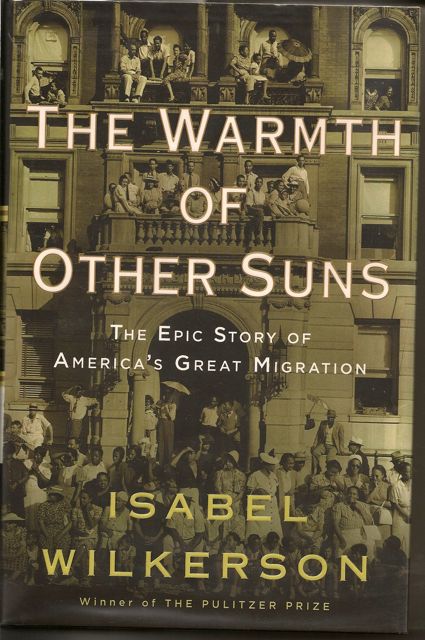 Isabel Wilkerson’s book, The Warmth of Other Suns – the epic story of America’s great migration, ((New York City, Random House 2010)) creates whole new planes of awareness of our history.
This book startled me to a new understanding of how encompassing and pervasive the Jim Crow laws and social rules of the South really were. Without much thinking on my part, I have always equated Jim Crow with images of separate water fountains, lunch counters, and schools, along with denial of voting rights. Included were images of lynchings and mob violence. Wilkerson’s work brings to life the real depth of the American system of Apartheid. These laws and social rules were so extensive as to lead to separate break times in factories so that whites and blacks would not even use a stairway at the same time.
This is the story of the six million African Americans who left the South for the North and West of the US between 1910 and WWII. Wilkerson builds her narrative of the main courses of this migration through the stories of three people leaving three different parts of the South, venturing to the three main destinations, NYC and the northeast, Chicago, and Los Angeles over three decades (teens through 40’s). Her overall research included interviews with over 1,200 people.
The stories do not end with the escape from the South. Wilkerson follows the stories as they unfold in their new environs. Here the transition from the oppressions of the South to the new realities of the north and west. No surprise the escape from the South did not mean an instant escape from racism institutionalized or otherwise. This part of the story is more familiar to a Northern urbanite.
This book, along with Douglas Blackmon’s Slavery By Another Name – the re-enslavement of Black Americans from the Civil War to WWII ((NYC Doubleday, 2008)) are compelling additions to understanding the history of racism in the US. Both are must reads.
adjective
- of undisputed origin; genuine : the letter is now accepted as an authentic document | authentic 14th-century furniture.
- made or done in the traditional or original way, or in a way that faithfully resembles an original : the restaurant serves authentic Italian meals | every detail of the movie was totally authentic.
- based on facts; accurate or reliable : an authentic depiction of the situation.
- (in existentialist philosophy) relating to or denoting an emotionally appropriate, significant, purposive, and responsible mode of human life ((definition adapted from Dictionary Version 2.1.1 Apple, Inc.)
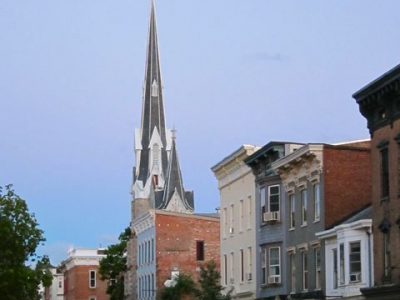
In part because of the vigorous discussion in the various “Signage” postings in the Hudson Business Coalition discussion group and other discussions I have had recently about Hudson, I have come to think that a major feature of Hudson is authenticity. Hudson demonstrates authenticity in all four senses described in the definition above. People who own businesses here, whether in antiques, art, music, and many more, do so from some central personal passion. Visitors experience this directly. Visitors must digest the experience and make it their own. And, many times businesses receive direct feedback about their passions from visitors and not in frequently new perspectives and information about their passions.
Just pay a visit to some of our B&Bs to see authenticity in action. For example, compare The Inn at Hudson and The Country Squire Bed & Breakfast. Just a hundred yards apart, but completely different experiences, each personal and real.
 This is no Disneyfied, corporate version of life, no predigested, cleaned up tourist consumable. A visit to an art gallery here is a visit to the owner’s interests in art. The same goes for the antiques. The burgeoning music scene is filled with lots of local music. The streetscape is authentic, even the maligned Columbia-State St. streetscape. The diversity of the population is authentic and, for a town of seven thousand, quite amazing.
I hope that Hudson continues to develop, in its chaotic unplanned way, with an eye on authenticity. A strong commitment to preserving the streetscape is one obvious strategy. How to encourage and maintain authenticity in other dimensions is not so clear.
A deeper problem is the moment when we reach the tipping point and developers decide that Hudson is hot. As Jane Jacobs wrote about in The Death and Life of Great American Cities (1961) success in the real estate world leads to the death of the social world. It is one of the seemingly inevitable consequences of private property rights that the “highest and best use” (for private property owners) always wins out over any social values. That is unless there are strong countervailing forces from government and an engaged alert citizenry.
 During my thirty five plus years living in Cambridge MA I watched the death of Harvard Square and its conversion into a social wasteland dominated by large institutional and corporate interests. Everything funky, fun, disruptive. original, everything that made Harvard Sq. a destination for locals, tourists, book lovers, poets, street musicians, and youth were driven out by large buildings filled with a parade of corporate logos and institutional uses. The only authentic use remaining in Harvard Sq. today is the gathering of teenagers, all from the suburbs, in the “mosh pit” around the entrance to the T. In contrast, Central Sq. in Cambridge might be a good case study of a neighborhood that has largely escaped this fate, though its is just a long half mile from Harvard Sq. It has somehow remained quite indigestible despite inroads by Harvard, MIT and a herd of banks.