Author Archives: markorton

10/1/2004 – Bush and the Saudis

Friday

Bush and the Saudis


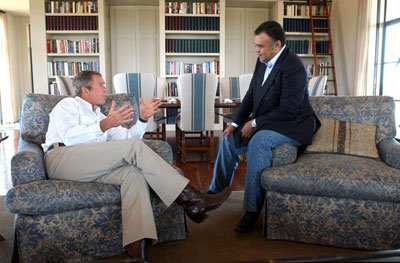
I saw this picture several months ago in the newspaper and was very struck by what it says about the relationship between Bush and Bandar, the ambassador from a foreign country. Today it popped up again in the current issue of the New York Review of Books. With only a few moments search I found the original color photo.

 
The caption in the New York Review of Books: “George W. Bush and Prince Bandar bin Sultan, Saudi Ambassador to the US, at Bush’s ranch in Crawford, TX, August 27, 2002.”

The body language and social conventions displayed here tell me the following:

This is a very comfortable social setting for the two of them, intimate even.

Bush is entirely at ease and not feeling the need to hold any poses with regard to Bandar or the presence of the photographer in the room. Bush is at a lower level looking up to Bandar.

Bandar for his part seems almost unimaginably familiar and casual with Bush. Put yourself in the living room of someone you know quite well. Would you sit on the arm of an upholstered chair to chat? Would you do this with the President of the US (or any other country for that matter)? Only if you had been in the house frequently and you were on very good relations.

Is there any further need top wonder that Bush arranged to have all of the important Saudi’s flown out of the US immediately after 9/11 while even hid mother and father could get a flight anywhere.

BTW – the credit for the photo: Eric Draper/White House website

9/29/2004 – Zinn & Chomsky at Bunker Hill Community College

Zinn & Chomsky at Bunker Hill Community College – 09/27/04


We went to Bunker Hill Community College Monday night to hear Noam Chomsky and Howard Zinn speak on the topic, “Is There Hope In This Desperate Time?”, at a fundraiser for the Homeless Empowerment Project. Our friend Linda Larson, former editor of our local street paper, Spare Change, took us along with KC Chapman from Jackson MS.

Zinn and Chomsky are two very vigorous guys even at there advancing ages.

The big take aways for me are the need for continuous political action whether it is around the war in Iraq, health insurance, homelessness, racism, whatever. Second, not surprisingly, they reiterated and supported the notion that the Republican and Democratic parties are just two different wings of a ruling elite that doesn’t want regular people involved in important issues. Chomsky said that if you are in a swing state you should go to the polls and vote for Kerry. Otherwise, vote for a candidate you like or abstain from the “quadrennial circus”. The important thing is to do something politically active on a regular basis. Voting, even in a real democracy, is just a five minute activity.

The forthcoming series of presidential debates with Kerry and Bush will illustrate how little anyone will talk about issues and how much focus there is on trivial “character” issues.

Chomsky illustrated this in the ongoing health care crisis. The US spends far more per capita on health care but produces results that are not better than Cuba or many other 3rd world countries. Attempts to change the gross inefficiencies of the health insurance and drug companies are always beaten back with phrases like “this isn’t practical”. This is just code language that the health insurance and drug company lobbies in Washington don’t want their times at the trough interrupted (or ended in the case of the useless, incredibly wasteful insurance industry).

It was bracing to hear two radicals speak so clearly and forcefully on public issues. It refocuses me on how little discussion of real issues happens in the US.

Getting Started – a progressive call to action

Thursday, September 23, 2004

Getting Started – a progressive call to action

The politics and cultural life of the US has increasingly been dominated by “the vast right-wing conspiracy” – the Bush Presidency is the culmination of formal processes underway for several decades and historical phenomena rooted in the earliest moments of the country.

These are difficult times for those of us who believe:

  • the separation of church and state (one of America’s great gifts to humanity) is fundamental to the health of our society and religious groups within it
  • our economy should produce jobs that pay a living family wage for everyone
  • health care and housing are rights for everyone
  • providing for the health and education of all children is an important duty of society as a whole and an investment in the future
  • the total costs of private enterprise activities must be kept private (for example, pollution, waste management, workforce health and injuries, etc.)
  • costs of public life should be shouldered fairly by all parties (including the rich and corporations)
  • the role of the US on the world stage is best served by a clearer focus on multilateralism, disconnecting from the neo-imperialist policies currently guided by the needs of corporate interests

We need a long-term program and platform to reenergize the progressive elements of our society. The present Democratic Party is not structured to capture the interests of the large majority of Americans who could support, out of their own self-interest, a more progressive vision.

Just as the right-wing elements have coalesced around the Republican Party and made it their vehicle over the last two-to-three decades, we need a long-term program and a platform to change the terms of the debate and move public processes in our direction to achieve our objectives.

This raise all sorts of questions. In the next few entries here I will tackle some of them.

2/10/2004 – The Interrotron – Errol Morris

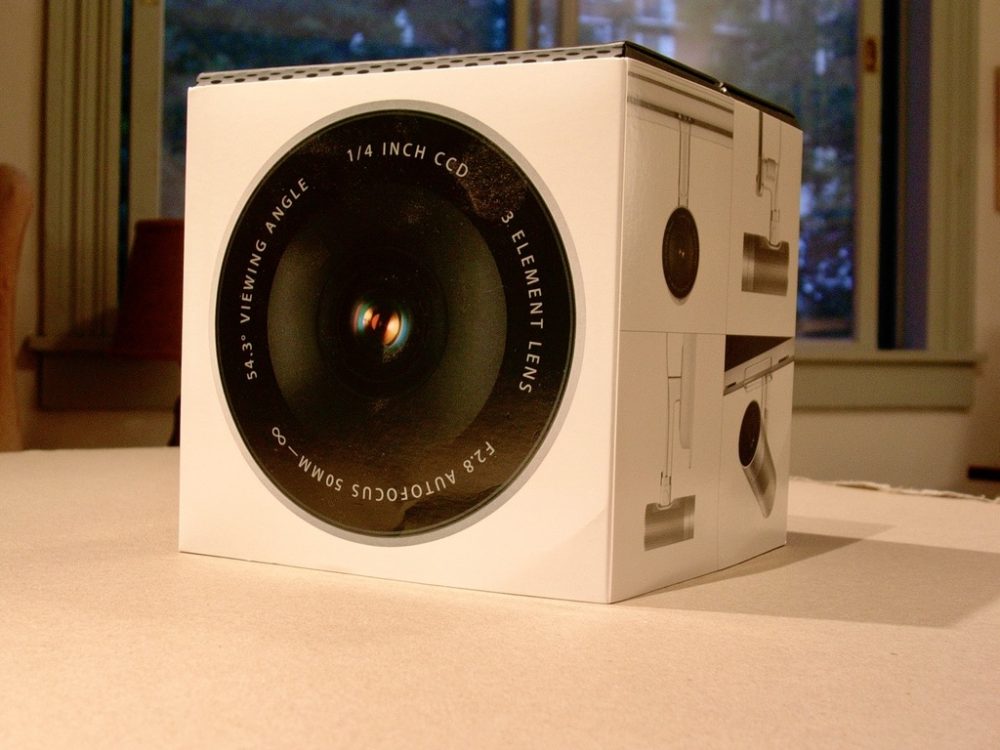
In a recent visit to the movies I picked up the FLM [Magazine] (Winter 2004), a product of Landmark Theatres, and found an article by Errol Morris, “13 Questions and Answers on the Filmmaking of Errol Morris”. It contained a bit of drollery about the Interrotron.

In The Fog of War and other Morris’ movies, the interview subjects stare straight into the camera while responding to a voice interviewing them from off screen.

Here is the text lifted without permission from the magazine’s website (http://www.movienet.com/fogofwar.html). I have attempted to maintain the design and layout. I did add the picture of the Interrotron from another source.

Q Is it true that you interview people using a machine?
A Yes, the (patent pending) Interrotron. It’s a machine that uses existing technology in a new and novel way. When I made my first film, Gates of Heaven, I interviewed people by putting my head right up against the lens of the camera. I would be talking to them, and it seemed as though they were looking directly into the lens of the camera, but not really. Almost, but not quite. Of course, they were looking a little bit off to the side.

Q Why? What’s the point?
A To create the first person. When someone watches my films, it is as though the characters are talking directly to them…There is no third party. On television we’re used to seeing people interviewed 60 Minutes style. There is Mike Wallace or Larry King, and the camera is off to the side. Hence, we, the audience, are also off to the side. We’re the fly-on-the-wall, so to speak, watching two people talking. But we’ve lost something.

Q What?
A Direct eye contact.

Q Eye contact?
A Uh huh. We all know when someone makes eye contact with us. It is a moment of drama. Perhaps it’s a serial killer telling us that he’s about to kill us; or a loved one acknowledging a moment of affection. Regardless, it’s a moment with dramatic value. We know when people make eye contact with us, look away and then make eye contact again. It’s an essential part of communication. And yet, it is lost in standard interviews on film. That is, until the Interrotron.

Q I don’t get it.
A I got tired of sitting so close to the camera. (In my early films, my cameraman would grab the back of my head and pull me back because you could see the side of my head in the lens. When he yanked me back, it often hurt.) And I started to wonder, what if I could become one with the camera. What if the camera and myself could become one and the same?

Q You’re losing me.
A Well, not literally. Are you familiar with Teleprompters?

Q Not really.
A Well, Teleprompters are used to project an image on a two-way mirror. Politicians and newscasters use them so that they can read text and look into the lens of the camera at the same time. What interests me is that nobody thought of using them for anything other than to display text: read a speech or read the news and look into the lens of the camera

.
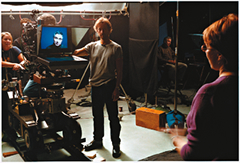
(image borrowed without permission from http://www.spin.com)

Q OK.
A I changed that. I put my face on the Teleprompter or, strictly speaking, my live video image. For the first time, I could be talking to someone, and they could be talking to me and at the same time looking directly into the lens of the camera. Now, there was no looking off slightly to the side. No more faux first person. This was the true first person.

Q It sounds like Buck Rogers. Were people willing to tolerate this?
A I worried at first. Would it frighten people? Would they run out of the studio screaming? Who could say? I used it for the first time in Fast, Cheap & Out of Control. And it worked like a charm. People loved
the Interrotron.

Q The Interrotron? Did you make up the name?
A No, it was named by my wife, Julia Sheehan. She liked the name because it combined two important concepts — terror and interview.

Q But doesn’t the device intimidate people?
A Oddly enough, no. It doesn’t. People, if anything, feel more relaxed when talking to a live video image. My production designer, Ted Bafaloukos, said, “The beauty of this thing is that it allows people to do what they do best. Watch television…” We often think of technology as
working against the possibility of intimacy. But there are so many counter-examples. The telephone is a good counter-example. There are things we can say to each other on the phone that we would never say if we were in the same room. You know, “Being there is the next best thing to using the phone…” The Interrotron is like that. It creates greater distance and greater intimacy. And it also creates the true first person. Now, when people make eye contact with me, it can be preserved on film.

Q Have you used it much?
A Whenever I need to. I used it in a film that introduced the Academy Awards® in 2002. Gorbachev, Laura Bush, Iggy Pop, Al Sharpton and Walter Cronkite have all been on the Interrotron.

Q Did Robert McNamara like it?
A Well, you have to remember that we are talking about someone who has been interviewed a thousand times. He walked into the studio and said, “What is that?” I smiled and said, “The Interrotron.” He said, “Well, whatever it is, I don’t like it.” But then he sat down, and we proceeded to record over twenty hours of interviews. I guess he came to like it, too.

A Fog of War or a Fog of Ethics?

Through our friend Esther Hanig we attended a showing of Errol Morris’s new documentary, The Fog of War: Eleven Lessons From the Life of Robert S. McNamara. at the Kennedy Library in Dorchester on December 14, 2003. This documentary is an extended adventure into the historico-biography of Robert S. McNamara, most famous as the Secretary of Defense during the Kennedy and Johnson administrations. The movie intersperses close up head shots of McNamara (always shown off center) responding to questions posed by the interviewer (never seen, but clearly the director Morris) with historical footage and graphics illustrating events or concepts.


McNamara today at age 87 McNamara as Sec. of Defense ca 1966.
Photos appropriated from the New York Times web site


One of the most effective sections reveals McNamara’s role in the planning and execution of bombing campaigns during WWII under the command of Gen. Curtis LeMay. This bombing campaign attacked 67 Japanese cities. Morris uses historical footage of the results and then flashes the names of the Japanese cities with their populations on the screen immediately followed by the names and populations of similar-size American cities. In one night a fire-bombing of Tokyo incinerated 100,000 civilians. In the movie, Mr. McNamara tells Mr. Morris. “Lemay said, `If we’d lost the war, we’d all have been prosecuted as war criminals.’ And I think he’s right. He — and I’d say I — were behaving as war criminals.” He asks, “What makes it immoral if you lose and not immoral if you win?” (thanks for this quote to the movie review article “War and Never Having to Say You’re Sorry” by Samantha Power, Published: December 14, 2003 in the New York Times)

Later, covering the Vietnam War, Morris provides audio tapes of both Kennedy and Johnson speaking with McNamara about the war. These add more fuel to the argument that if Kennedy had lived that he would not have enlarged the US involvement. And, on the other hand, Johnson comes across as clearly responsible. No surprise there.

When asked during the post-screening discussion about why he waited for over twenty years to reveal that he had come to think the Vietnam war a mistake even while still Sec. of Defense, McNamara repeated his claim that as a former Sec of Defense he could not say critical things of the war policy because it would have been giving comfort to the enemy and endangering US troops.

This is a cruel bit of logic.

When McNamara left his position roughly 25,000 Americans had died and probably 10 to 20 times that many Vietnamese. By the time the war actually ended seven years later, more than twice that many had died on both sides. It remains a galling outrage that this man, so intimately involved with the development and prosecution of the Vietnam War, could be seeking absolution twenty years later. It is the minimum we human beings owe to each other that, when confronted with obvious wrong doing, we speak up. This obligation is all the more important for those in positions of power and authority. But, one of Morris’s points in his movie is that evil and evil doers are never quite so easily categorized as might be in an old Western movie.

The end of the post-screening discussions with McNamara displayed this point with fresh vigor. After the program was officially closed, McNamara called for a few more moments of the audience’s attention. He wanted to add to his call for work on developing and deploying a real policy on proliferation of nuclear weapons with a call for international standards for behavior by political leaders enforced by international judicial tribunals. Perhaps we might think of him in the dock for his role in the Vietnam War. Just as a small starting point for the prosecution: during the movie McNamara himself pointed out that more munitions were dropped on Vietnam during the war than all that were used in the European theatre of WWII. And, this, in a country that is just about the same land area as our states of Wisconsin and Minnesota and then, as now, one of the poorest countries in the world.

But, then, McNamara seems incapable of connecting the ethical dots in his own life. How can acknowledge that his role in the fire-bombings of Japan might be considered a “war crime”, his policy in Vietnam wrong, and call for international standards of behavior enforced by international courts??

PS: I highly recommend the movie. It is challenging and very well made.

12172003

10/12/2003 – Milt Rogovin – photography

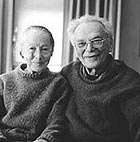
Milton and Anne Rogovin – June 2003

During one of our whirlwind weekends in New York, Karen and I went to the New York Historical Society (2 West 77th Street New York, NY 10024 http://www.nyhistory.org) to catch the last day of the exhibit, REMEMBERING THE FORGOTTEN ONES: THE PHOTOGRAPHS OF MILTON ROGOVIN.

This proved to be the best photography, most engaging exhibit I have seen in years.

“A joint project of the NYHS, Sound Portraits Production (the Society’s collaborators on the 2001 exhibition Flophouse ), and the Burchfield-Penney Art Center in Buffalo, this remarkable exhibition combines prime examples of 93-year-old Rogovin’s photographs of Buffalo over five decades (including recent work), with audio installations and artifacts. The exhibition is accompanied by a short film, The Forgotten Ones , directed by Harvey Wang (which won the Best Documentary Short award at the 2003 Tribeca Film Festival), and a new book, Milton Rogovin: The Forgotten Ones (with Dave Isay, David Miller and Harvey Wang; published by Quantuck Lane Press in June, 2003).”

(from the New York Historical Society web site)

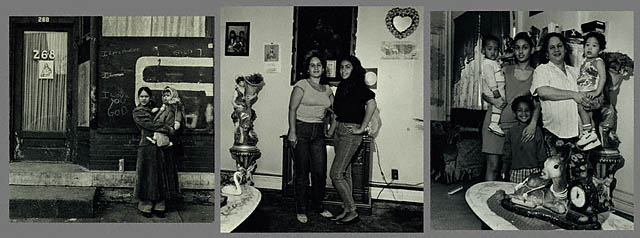
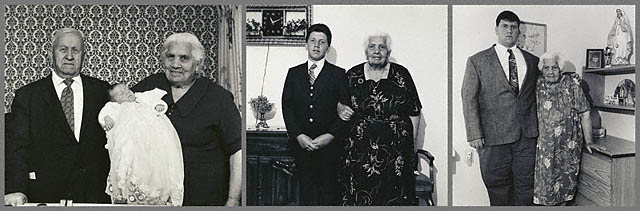
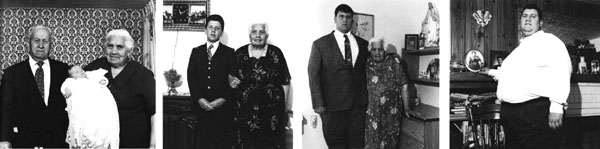
At the heart of the experience was a roomful of tryptichs, photos taken of the same family, if not always the same family members spanning three decades. Rogovin combined brief texts by one or more of those pictured and some included audio versions with the authors of the text speaking.

Here are a few images:

Eva and Daughter 1972, 1985, and 1992 (image borrowed without permission from The Getty Museum (http://www.getty.edu/art/collections/objects/o112420.html)

Grandparents and Baptism Boy 1974, 1985, 1992 (image borrowed without permission from The Getty Museum http://www.getty.edu/art/collections/objects/oz112421.html)

And an updated “quartet” extending the one above:

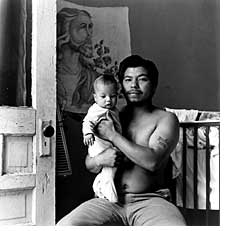
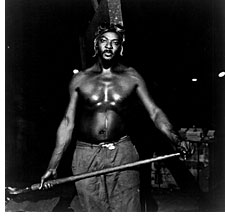
Here are a couple of other pictures gleaned from various web sites:

(from the Working People series)


There is a Milton Rogovin website.


Year in Pictures – July 16 thru July 24, 2003

Wednesday July 16, 2003

This large green bowl that Karen really liked proved not to be microwave-safe. It broke in my hands as I began to wash it after reheating the evening pot roast.07162003BrokenBowljpg


Thursday July 17, 2003

A detail from an arbor at the top of Franklin St at Putnam Ave.07172003ArborFranklinSt

The finishing touches are now being made at the Franklin St pocket park.

The maker of this steel sculptural fence turns out to be Murray Dewart (more below on him).

He was working on it when I walked by. He listened politely as I expressed the observation that the granite pillars are out of proportion to the entrance. Go back to the July 10 entry for a photo and my comments then.

Apparently this is all part of his design. We will see how it works out.

07172003FranklinStPark_fenc 07172003MurrayDewart

07172003dewart

Jerusalem’s Gate by M. Dewart in the Forrest Hills Cemetery Sculpture Path: Murray Dewart

07172003Dewart2

Gee, does this piece suggest a solution that might fit in at Franklin St.??


Friday July 18, 2003

07182003AndrosDinerDinner Friday: When we went by the Miracle of Science down near MIT on Mass Ave, one of our regular spots, it was mysteriously full. So, off to visit an old haunt that we have not been in for five or six years. the papers recently spoke highly of a refreshed cuisine. We only found the dependable old one and the same crowd of locals in search of cheap serviceable food.
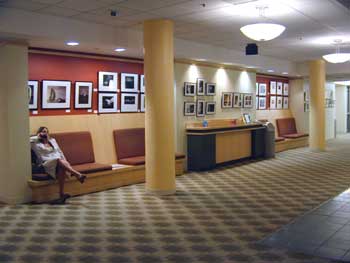

After dinner, we went to take a look at the Photography Atelier show (Photography Atelier) (opens new window) hung at Lesley University’s (Lesley University (opens new window) space in the former Sear’s Building in Porter Sq. (now known as the “Porter Exchange”. Even though I might be accused of nepotism, Karen both teaches the course and has work in the show, it is quite good. If you happen into the Porter Exchange for the endless Asian foods on the first floor, take the elevator to the fourth.

07182003PhotoAtelierLesley


Saturday July 19, 2003

A weekend trip to Miriam Goodman’s cabin in Nelson NH. 

07192003MTMonadnockView

Looking down the meadow from Miriam’s cabin south towards Mt. Monadnock (right rear of picture)

07192003M_GoodmanCabin

Miriam’s cabin


Nelson, NH


Sunday July 20, 2003

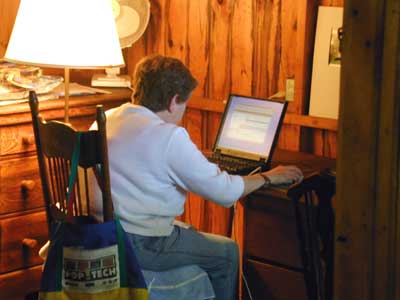
We left Miriam’s cabin around 11 am. She was already getting connected as we departed:

07202003MGoodmanConnected

Lunenburg MA

We stopped in Jaffrey, NH to have iced tea with friends Bonnie and Martin. From there we took the “scenic” route home. This included a stretch on Rte 2A that leads through Lunenburg.

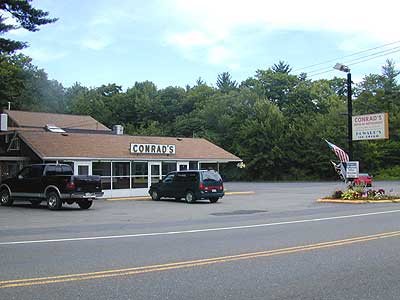
We had a picnic lunch from our cooler full of cold roast chicken augmented by some of Dave’s special cole slaw and a dill pickle at Conrads on 2A in Lunenburg.07202003ConradsLunenburg 07202003KarenConradsLunen

07202003BaseballLunenburg

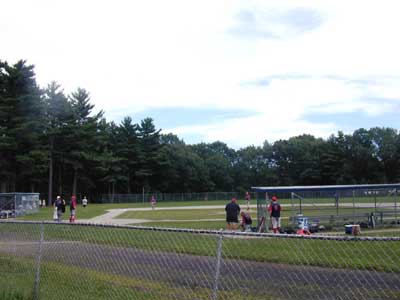
Baseball field Lunenburg

Just for the nostalgia, since I grew up to age 14 in Lunenburg, we stopped by the ball field and the old house on Main Street

Our old house on Main St. Lunenburg